AI Will Make Insurance Appeals Easy. The Better Business Makes Them Unnecessary.
AI can help more patients challenge insurance denials. The bigger opportunity is to prevent avoidable denials — and build a business that gets paid for helping patients reach care sooner.

In brief
AI will make insurance appeals cheaper to prepare, but payers have the same incentive to automate review. When both sides keep optimizing, cost per exchange falls while exchanges per case multiply, and the patient still waits. The bigger opportunity starts at the order, not the denial: surface payer requirements early, fix missing documentation once, prevent the avoidable appeal. It is harder to sell because prevented work has no budget owner. That is why it is worth building.
The appointment is on the calendar. The MRI is ordered. Then the patient gets a call: insurance has not approved it.
An authorization specialist gathers records. A nurse reviews the chart. Someone contacts the insurer. The patient rearranges work, wonders whether to keep the appointment and waits for another call.
An AI company offers to handle the appeal. It will find the policy, assemble the evidence, prepare the submission and follow the case through resolution.
That is useful. For an overwhelmed clinic and an anxious patient, it is enormously useful.
But there is a bigger product opportunity hiding inside that promise: what would it take to prevent this particular denial from happening?
That question leads somewhere more interesting than another tool for generating appeal letters. It leads to a different way of building healthcare AI companies—one that connects the work they automate to the patient’s journey, the buyer’s budget and the behavior of the organizations on the other side.
Here is the tension. AI will make appeals cheaper to prepare. Payers have the same incentive to automate their response. Both sides can become more efficient while the process between them becomes more elaborate.
The companies worth watching will understand that trap. They will use automation to remove avoidable rounds of work, and they will prove that patients reach appropriate care sooner.
There is a substantial business to build there. First, we need to be precise about what the customer is buying.
From healthcare software to completed work
An AI-native healthcare service takes responsibility for delivering a defined piece of work, using software and people together. The customer delegates the process instead of buying a tool and assigning employees to operate it.
For prior authorization and appeals, that is an important change.
In our illustrative MRI case, the appeal begins well before someone writes a letter. A specialist checks coverage, retrieves the relevant payer policy, examines the denial and identifies the documentation needed. A nurse reviews the clinical record. Records from another office may be missing. Depending on the case, reconsideration or a peer-to-peer discussion comes before a formal appeal.
Submission is followed by tracking, questions and sometimes another round.
A software vendor helps staff manage those activities. A managed AI service offers to perform them. The difference shows up in four places. With a software tool, the customer buys software that its own staff operate, runs the process itself, pays by subscription or seat, and measures usage and staff productivity. With a managed AI service, the customer buys a defined piece of work delivered, the vendor runs the process within an agreed scope, pricing is per case or contracted result, and performance means resolution, turnaround and delivery cost.
The vendor’s promise should be specific: send us the denial, and we will pursue the appeal through resolution. No vendor can guarantee that every denial deserves reversal. It can accept responsibility for completing the work, escalating difficult cases and keeping the customer informed.
This opens a route to market for companies that employ authorization specialists and nurses alongside engineers—the digital-worker model applied to one of healthcare’s most adversarial workflows. People make the service dependable while the company learns which tasks software can handle.
The first product is the delivery operation itself.
Why cheaper appeals matter to patients
There is good reason to welcome better access to appeals.
KFF’s analysis of 2025 insurer data found that appealed standard prior-authorization denials were overturned 67% of the time in Medicare Advantage, 47% in Medicaid managed care and 43% in the federally facilitated ACA Marketplace. KFF also reports that denials are rarely appealed. [1]
These figures describe the cases that were challenged; they do not tell us how every unappealed case would have turned out. Some reversals follow the submission of additional documentation.
For some patients, access depends on reaching a second administrative process that requires time, persistence and expertise.
A service that makes that process accessible is creating something valuable. It gives a clinic capacity it otherwise lacks. It helps a patient who cannot navigate the process alone. It creates a clear owner for work that otherwise passes between inboxes and phone calls.
There is an important distinction here. More appeals can mean more people obtaining appropriate care. Additional treatment spending is not evidence that automation has failed. The waste we should worry about is repeated administrative activity that does little to improve the decision and leaves the patient waiting.
That distinction should stay with us throughout the article. The goal is not to minimize appeals at any cost. It is to reduce the avoidable obstacles between a patient and an appropriate decision.
An appeals service can advance that goal. Its own efficiency metrics, however, cannot tell the whole story.
What happens when both sides automate?
An appeals company operates against a counterparty whose workload changes when appeals become cheap.
If preparing an appeal requires substantial staff time, a clinic has to make difficult choices about what it can pursue. Reduce that burden, and more cases become practical to challenge. The insurer now receives more submissions. It has a reason to automate review. The risk develops when both parties keep optimizing against each other.
Here is the feedback loop to watch:
- Providers reduce the cost of preparing appeals. AI retrieves documents, organizes evidence and produces drafts.
- Providers challenge more denials. Cases previously left unresolved now receive attention.
- Payers automate review. They respond to the increased workload and manage the resulting expenditure.
- Providers learn which submissions succeed. Their systems adapt wording, document structure and evidence presentation.
- Payers adjust their review systems. Providers then adapt to those changes.
- Both sides increase throughput. Each organization processes transactions more cheaply.
- Repeated exchanges consume the savings. If rounds of review grow faster than unit costs fall, administrative expense per episode rises.
The final step is arithmetic. Halving the cost of a round does not save money if the number of rounds triples.
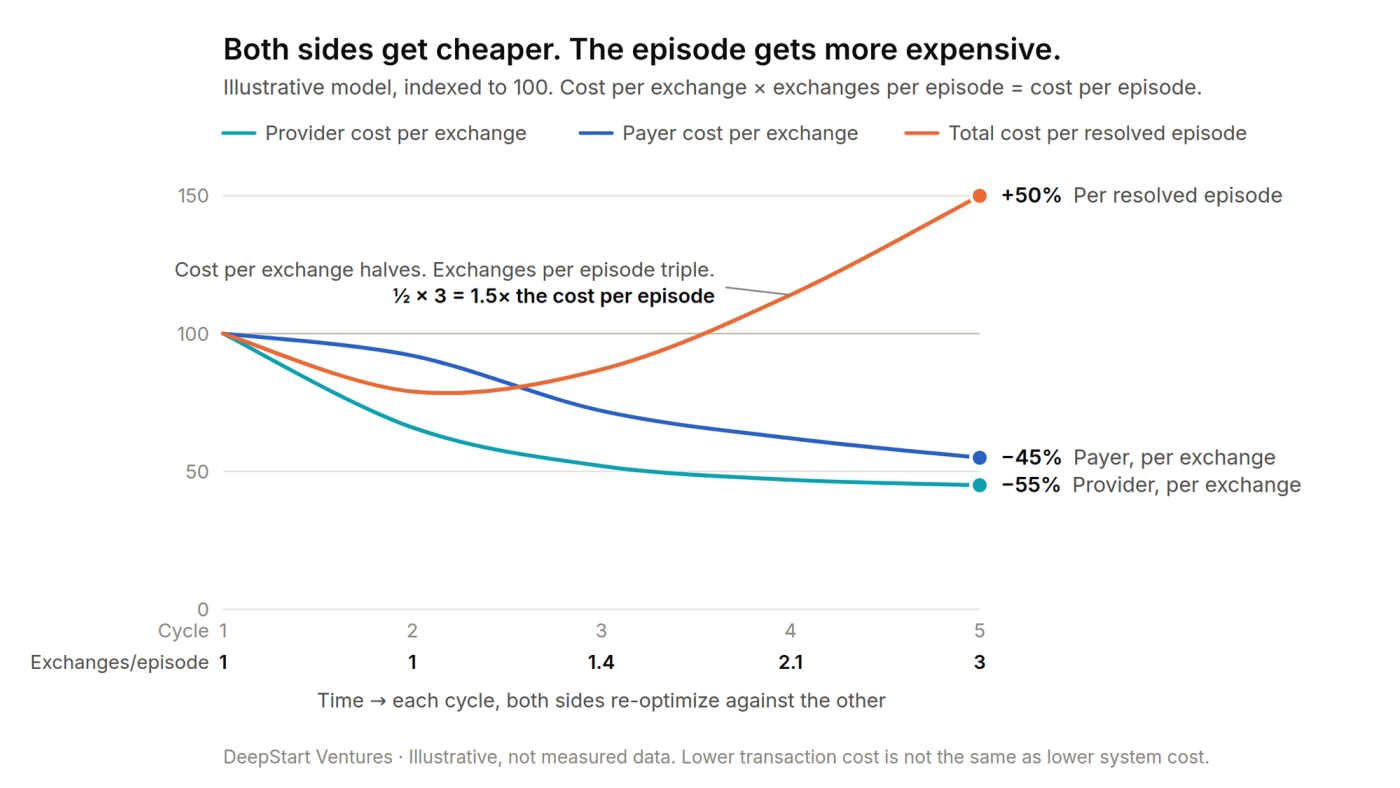
My prediction is that some AI companies will build excellent businesses inside this loop. Their customers will see lower processing costs and better results on their own side. The combined process will become harder to evaluate precisely because every participant can point to evidence of improvement.
That is why cost per appeal cannot stand in for progress.
The more subtle risk sits in steps four and five. Over successive rounds, the signals that win approval could drift away from the clinical facts the process is meant to assess. The written policy need not change. Relevant information might be overlooked because it appears in an unfamiliar format. A carefully optimized submission might advance because it resembles previously successful cases.
This is a failure mode to investigate, rather than an established description of every automated review system. It gives product teams a concrete test: does the system improve the evidence available to the reviewer, or mainly improve its ability to satisfy the reviewer’s classifier?
A useful evaluation would hold the clinical facts constant while varying presentation. If wording changes the recommendation without changing the evidence, the team has learned something important about its product.
Lower transaction cost is not the same as lower system cost.
The better product starts before the denial
Return to the patient waiting for the MRI.
An appeals product starts with the denial. A prevention product starts with the order.
It identifies whether authorization is required, retrieves the relevant requirements and checks whether the available record supports a complete submission. When something is missing, it tells the appropriate person what is needed while the case is still close to the clinical encounter.
Consider a simple product design.
The system flags a missing document. It names the source of the requirement and shows which records it checked. A staff member retrieves the missing record or confirms that it is unavailable. If the case requires clinical interpretation, it goes to a qualified professional with the relevant material assembled.
The system then tracks the request through decision and communicates its status to the people who need it.
This is a proposed workflow, not a claim that every requirement can be reduced to a checklist. Clinical uncertainty and legitimate disagreements will remain. The product’s job is to prevent avoidable incompleteness from becoming a dispute.
One boundary separates this product from an arms-race product wearing a prevention label. It never invents supporting evidence, never steers documentation toward a desired answer and never quietly changes the treatment request to improve its approval rate. A product that optimizes for approval is playing the loop. A product that optimizes for completeness is exiting it. That line is also what a payer would need to see before trusting a provider-side vendor, and it belongs in the product’s design principles, not its marketing.
The appealing part of this product is how ordinary the successful experience becomes. A requirement is visible early. Missing information is addressed once. Someone owns the next step. The patient knows what is happening.
A great outcome would leave very little story to tell.
The 2027 prior-authorization deadline creates a starting market
There is a concrete reason to build toward that experience now.
CMS-0057-F requires prior-authorization APIs, with compliance generally beginning January 1, 2027. Certain operational requirements generally began January 1, 2026. Exact timing varies by payer type. [2]
The rule covers Medicare Advantage, Medicaid and CHIP fee-for-service and managed care, and qualified health plan issuers on federally facilitated exchanges. It excludes drugs from these prior-authorization requirements and does not impose them on employer-sponsored commercial plans.
The APIs must support discovering documentation requirements, submitting requests and receiving approvals, denials with specific reasons, or requests for more information. They establish information exchange, rather than common clinical criteria or a shared adjudicator.
My bet is that the mandate forces the infrastructure and the value moves upstream.
The commercial opening is to connect that infrastructure to work happening inside a practice: retrieving the right information, identifying gaps, routing decisions and keeping the case moving.
Founders have a defined starting market with a compliance date attached. The longer road into employer-sponsored coverage remains. Treating the mandate as universal would produce the wrong market plan.
The first product should therefore have clear boundaries: a particular service, provider setting and payer population. That makes it possible to learn whether earlier intervention actually prevents repeat work before expanding into more complicated cases.
The product that prevents the appeal will be harder to sell
Having run a regulated health company, I pay particular attention to the distance between creating value and finding the budget that pays for it.
“Help us win more appeals” has an identifiable customer: a team responsible for authorizations, denials or revenue recovery. The return can be expressed in resolved cases and recovered dollars.
“Help us avoid appeals” distributes the benefit. The clinician experiences fewer interruptions. The patient gets a clearer path to care. Administrative teams have less work. The payer spends less on review.
Which of them owns the budget?
Prevented work is harder to count than recovered revenue. A dispute that never happens does not appear in the recovery report. The founder has to identify a buyer whose authority and performance measures recognize prevention.
This should happen during product discovery, before a team spends months building integrations.
Map the workflow with a prospective customer and ask who can authorize spending, who supplies the staff, and who receives credit when performance improves. Those may be three different people. Then agree on which benefit will support the purchase.
For one customer, it might be fewer staff hours spent chasing incomplete cases. For another, fewer appointments disrupted by unresolved authorization. Those are proposed sources of value to test, not assumptions to put into a sales deck.
Build the economic case from the customer’s baseline. Avoid adding together overlapping benefits or counting every minute saved as a cash saving. Time freed for other work is valuable, but it is different from money removed from a budget.
A product that prevents appeals needs a measurement agreement almost as much as it needs a contract.
Pincus’s product lesson: protect the insight, test the implementation
Mark Pincus makes a useful distinction in Life at the Speed of Play: a founder’s underlying instinct can be right while the particular product idea is wrong. [3]
For this market, the instinct might be that patients should not depend on an overburdened clinic having spare time to pursue an authorization.
That does not establish whether the right product is an appeal service, an intake workflow, an ordering assistant or an integration inside an existing system.
His Proven–Better–New framework gives teams a way to examine those alternatives. Copy what already works for the audience. Make improvements so clear that ten out of ten users recognize them. Isolate genuinely new ideas and test them.
The warning is that a founder’s idea of “Better” may actually be “New.”
In an authorization workflow, retrieving a record faster is an improvement customers can evaluate. Giving an agent authority to select the clinical justification for treatment changes the decision itself. Removing an existing professional review changes who is responsible for catching mistakes.
Treat that transfer of authority as another productivity release, and the distinction between Better and New is left for an incident review—or a deposition—to uncover.
A practical product review should list the system’s permissions separately:
- Retrieve and organize existing information.
- Identify missing documentation.
- Draft a submission.
- Select evidence for professional review.
- Submit within an approved scope.
- Communicate a decision or recommendation.
Each additional permission needs a reason. Faster execution does not provide one by itself.
This is also where a small test earns its value. A team can deliver the service manually with AI assistance, compare drafts with specialist judgments and record corrections before introducing greater autonomy.
The point is to learn which version solves the customer’s problem before committing to the most ambitious implementation.
Use the service to learn what deserves automation
The people inside an AI service are more than a temporary labor expense. They are the company’s closest observers of the work.
An authorization specialist knows where a case stalls. A nurse can explain why two apparently similar submissions need different handling. A physician can identify when an escalation arrives without enough context to make a decision.
That knowledge only becomes a product advantage if the company captures and uses it.
For every intervention, record what was missing, what the system proposed, what the person changed and why. Review recurring patterns. Some will lead to better retrieval or a clearer interface. Others will show where the company should preserve professional involvement.
A high intervention rate does not automatically mean the model needs to improve. It might mean the workflow is poorly designed, the source information is unavailable or the task has been assigned to the wrong person.
That distinction matters commercially. Otherwise, the company can spend heavily on model development to solve a coordination problem.
There is another encouraging possibility: the best product improvement may be very small. A clearer request for one missing record could remove several calls. Delivering the right evidence with an escalation could save a clinician from reopening the whole chart.
These changes will rarely produce a spectacular demonstration. They are exactly the changes that make a service worth renewing.
The test is whether each completed case teaches the company how to make the next one easier without transferring the burden elsewhere.
Measure the patient’s journey, then the company’s efficiency
Start with the patient’s time to appropriate care. Then examine qualified human minutes across the episode, followed by total administrative cost.
That ranking keeps the product’s purpose visible.
For the MRI example, record the time from the original order to the scan, while tracking the authorization stages separately. Keep clinical changes, cancellations and patient choices distinguishable from administrative delays. A single average cannot explain all of them.
Count the specialist preparing the case, the nurse checking it, the physician interrupted for review and the people handling the payer’s response.
Count unresolved and abandoned cases too. Otherwise, successful completions make the process look better while the people still waiting disappear from the denominator.
Start the patient’s clock at the original order. Starting the clock when the vendor receives a complete file would erase much of the waiting we are trying to understand.
For a pilot, agree on these definitions before the first case arrives. Compare similar case types and payer populations. Track how many exchanges each episode requires, how often the system escalates and how much work returns to the clinic.
Look beyond the average. A shorter typical turnaround is welcome, but the longest waits deserve attention, especially if difficult cases are being pushed out of the automated workflow.
A provider’s vendor will not always have access to payer labor costs. That is a measurement gap to acknowledge and work on. It is not a reason to treat one company’s efficiency as evidence of system-wide progress.
If care begins no sooner, the cost savings may still be worthwhile. They do not establish that the access problem has improved.
A better brief for the next healthcare AI product
The useful product brief is more demanding than “automate appeals.”
Choose a bounded workflow. Identify an accountable buyer. Establish where the waiting begins. Determine which repeat exchanges are avoidable. Test whether earlier access to requirements and better preparation actually removes them.
Then build the service around what the evidence shows.
For an existing appeals company, this creates an expansion path. The cases it handles reveal which failures recur. With permission and appropriate data access, those patterns can guide a prevention product: intervene earlier on the specific problems the service repeatedly resolves.
But expansion should earn its place. Sharing a customer or a dataset does not mean the next workflow has the same buyer, risk or economics.
At DeepStart, these are the three questions we carry into every product review or purchasing conversation in this category:
- What outcome is the customer buying, and who bears the consequences when the system is wrong?
- Are effort and cost falling across the whole episode—and is the patient reaching appropriate care sooner?
- Which behaviors described as improvements actually introduce new decision-making authority?
These questions give founders a way to prioritize, buyers a way to compare vendors and investors a way to distinguish a growing operation from an improving system.
They also leave room for optimism. We do not need a system capable of practicing all of medicine to make a meaningful difference. We need well-designed products that complete specific tasks, make uncertainty visible and reduce the amount of work required to reach a sound decision.
Give the patient less to fight through
A good appeals company can help people who otherwise have little chance of navigating the process. That is real value. The harder task is ensuring its success contributes to a shorter path through healthcare rather than another layer of competition around it.
Some companies will make healthcare cheaper. Some will make the fight faster. Follow the patient from the original order to care, and the difference becomes much easier to see.
We will have plenty of evidence that AI can prepare a better appeal. The more useful question is whether the patient still needs one.
For the patient in our example, the best outcome is wonderfully unremarkable: the necessary information is assembled, the request receives an appropriate decision, and the next step happens without weeks of uncertainty.
Nobody needs to marvel at the technology. They need to know whether to keep the appointment.
A note on sources
The prior-authorization figures are KFF’s analysis of insurer-reported 2025 data. The CMS-0057-F dates and scope are from the agency’s fact sheet. The cost curves shown in the figure are an illustrative model, not measured data.
“We will have plenty of evidence that AI can prepare a better appeal. The more useful question is whether the patient still needs one.”
Questions this article answers
How often are prior authorization denials overturned on appeal?
Often — when they are appealed at all. KFF’s analysis of insurer-reported 2025 data found that appealed standard prior-authorization denials were overturned 67% of the time in Medicare Advantage, 47% in Medicaid managed care and 43% in the federally facilitated ACA Marketplace. KFF also reports that denials are rarely appealed. Those figures describe the cases that were challenged, not how every unappealed case would have turned out.
What happens when both providers and payers use AI for prior authorization?
A feedback loop. Providers make appeals cheaper and challenge more denials; payers automate review to manage the volume; each side then tunes its system to the other’s. Cost per exchange falls on both sides while exchanges per episode multiply. If rounds grow faster than unit costs fall, total administrative cost per resolved episode rises — and the patient still waits. Lower transaction cost is not the same as lower system cost.
What is CMS-0057-F and when does it take effect?
The CMS Interoperability and Prior Authorization Final Rule. It requires impacted payers — Medicare Advantage, Medicaid and CHIP fee-for-service and managed care, and qualified health plan issuers on federally facilitated exchanges — to implement prior-authorization APIs, with compliance generally beginning January 1, 2027; certain operational requirements generally began January 1, 2026. It excludes drugs and does not apply to employer-sponsored commercial plans. The APIs standardize information exchange, not clinical criteria.
What does a product that prevents prior authorization appeals actually do?
It starts at the order instead of the denial: it identifies whether authorization is required, retrieves the payer’s documentation requirements, checks whether the record supports a complete submission, tells the right person what is missing while the case is still close to the clinical encounter, routes clinical judgment to a qualified professional, and tracks the request through decision. It never invents evidence, steers documentation toward a desired answer or alters the treatment request to improve approval odds.
Why is a product that prevents appeals harder to sell than one that wins them?
Because “win more appeals” has an identifiable buyer — an authorization, denials or revenue-recovery team — and a return expressed in recovered dollars. “Avoid appeals” spreads the benefit across clinicians, patients, administrative staff and the payer, and prevented work never shows up in a recovery report. The founder has to find a buyer whose authority and performance measures recognize prevention, and agree on how avoided work will be measured, before building integrations.
How should a healthcare AI company measure whether it is actually helping patients?
Rank the metrics. First, the patient’s time from the original order to appropriate care, with unresolved and abandoned cases kept in the denominator. Then qualified human minutes across the whole episode, including the payer’s side where visible. Then total administrative cost per resolved episode. Savings inside a vendor’s own workflow do not establish that access improved; if care begins no sooner, the efficiency gain is real but the access problem is not solved.
Key takeaways
- An AI-native appeals service sells completed work, not software — and its own efficiency metrics cannot show whether the system around it got cheaper.
- When providers and payers both automate, cost per exchange falls while exchanges per episode multiply; lower transaction cost is not the same as lower system cost.
- The better product starts at the order: surface requirements early, fix missing documentation once, and prevent the avoidable denial rather than fight it.
- CMS-0057-F gives founders a starting market with a compliance date — prior-authorization APIs by January 1, 2027 — but it excludes drugs and employer-sponsored commercial plans.
- Prevention is harder to sell than recovery because prevented work has no obvious budget owner; find the buyer and agree on measurement before building integrations.
Sources
- Prior Authorization Metrics Provide New Insights into Insurer Practices, but Gaps Remain — KFF (Report)
- CMS Interoperability and Prior Authorization Final Rule (CMS-0057-F) — fact sheet — Centers for Medicare & Medicaid Services (Primary data)
- Life at the Speed of Play: Launch Products People Love! — Mark Pincus (HarperCollins) (Article)
Building in healthcare AI?
Explore Health AI Launch →Keep reading
Related Insights
Working on something this article touches?
Work With DeepStart