The Healthcare AI Evidence Ladder: Why Benchmarks Don’t Tell You What Happens to Patients
Frontier models now beat specialized clinical tools and physician baselines on increasingly hard tests. The harder question is what those scores say about a real patient, a real clinician and a real workflow.
In brief
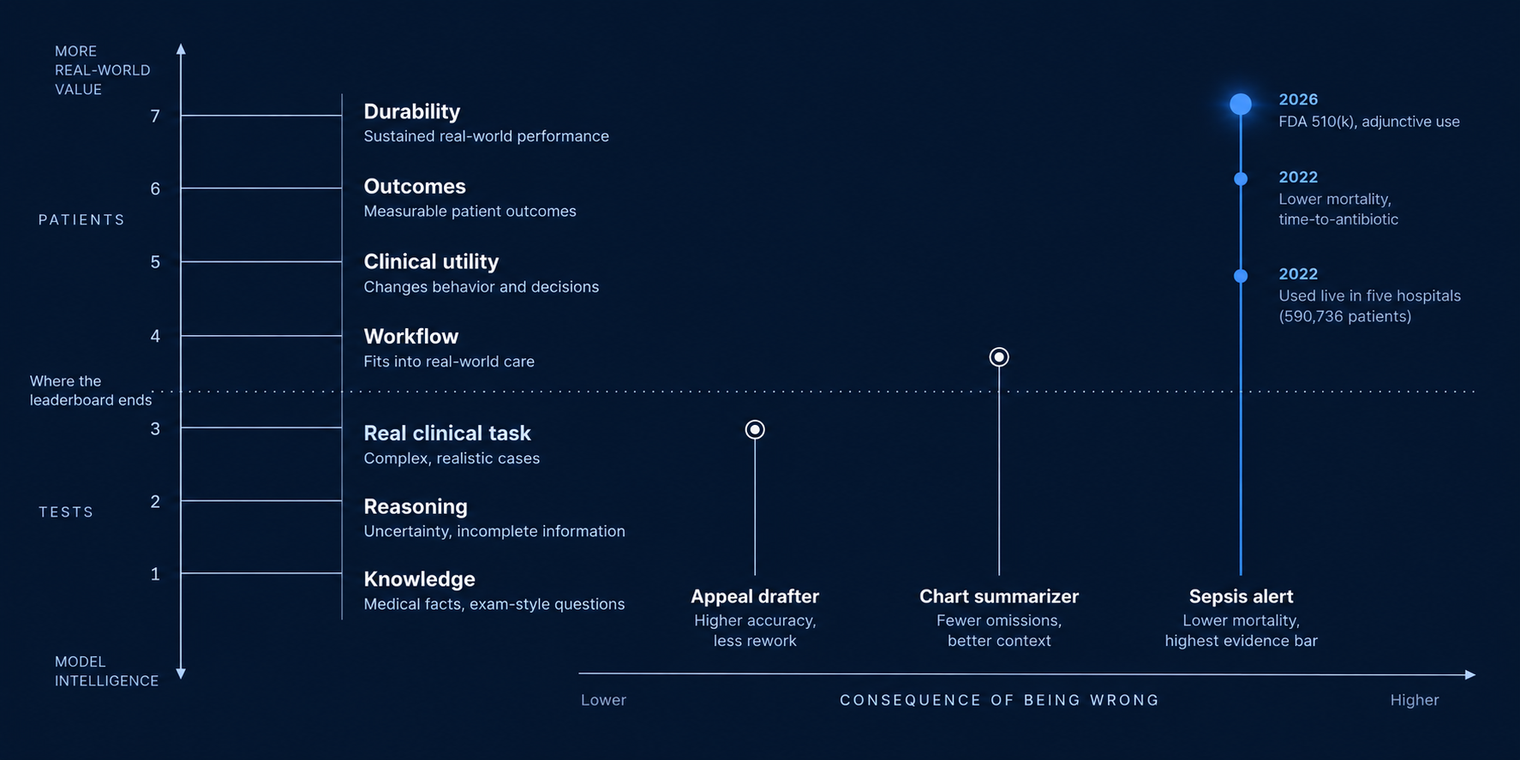
Benchmark scores measure the bottom of a seven-rung evidence ladder: knowledge, reasoning, real clinical task, workflow, clinical utility, outcomes, durability. The evidence a healthcare AI product needs should rise with its consequence — an appeal-drafting tool can be judged on accuracy and time saved; a system that changes treatment needs prospective evaluation, validation in its population and post-deployment monitoring. The bottleneck is no longer intelligence. It is evidence.
On June 12, 2026, Nature Medicine published a comparison that should make almost everyone in healthcare AI uncomfortable. Researchers at NYU Langone tested two specialized clinical AI products — OpenEvidence and UpToDate Expert AI — against three general-purpose frontier models: GPT-5.2, Gemini 3.1 Pro and Claude Opus 4.6. [1]
They started on familiar ground: 500 MedQA questions and 500 HealthBench cases. Then they built something more revealing — a Real Clinical Queries benchmark of 100 de-identified questions physicians had actually typed into a general-purpose model inside a live clinical environment. Twelve U.S. clinicians reviewed the answers blind, producing 1,800 model–question annotations. The frontier models outperformed the two specialized tools on all three evaluations, and on the real physician queries the specialized products performed about as well as Google’s AI Overview. [1]
That sounds like a model horse race. It isn’t the important finding. The important finding is that healthcare AI is now advancing faster than the tests we use to judge it. A model can ace a medical exam, outperform a product built specifically for doctors and beat physician baselines on hard reasoning tasks — and none of that tells you what happens when it enters medicine.
The next bottleneck in healthcare AI may not be intelligence. It may be evidence.
This is the third piece in a series. The field guide covers where AI is working in healthcare today and what physician founders should build. The excluded middle argues that the next companies will be built between visits, where AI is thinnest. This one is about the question both of those raise: how do you know whether any of it works?
Why are medical benchmarks running out of room?
When AI fails the exam, you make the model smarter. When it aces the exam, you need a harder test.
In April 2026, Science published another striking study. Across five clinical-reasoning experiments, with baselines drawn from hundreds of physicians, a large language model outperformed the physician baselines. The researchers also ran a real-world second-opinion study on emergency-department patients at a major academic medical center. [2]
The conclusion mattered more than the scores. The authors did not say physicians had become obsolete. They argued that large language models had eclipsed many traditional clinical-reasoning benchmarks and that the field now needed prospective trials. [2] That is the right instinct. When AI fails a medical exam, the obvious next objective is a smarter model. When AI starts acing the exam, the next objective is a harder test — because medicine is not a benchmark.
Why is a patient not a vignette?
Benchmarks assemble the patient for the model. Real medicine starts several steps earlier.
Medical benchmarks do something very helpful for the model: they assemble the patient. Here are the symptoms, the history, the labs, the scan — now answer the question. Real medicine starts several steps earlier. A patient says, “I’ve just felt strange for a few weeks.” They forget one of their medications. A specialist’s recommendation sits in an outside record nobody has pulled. The chart carries a diagnosis copied forward from three years ago. The symptom that changes the differential appears halfway through the conversation. Sometimes the patient is asking the wrong question entirely.
HealthBench was built partly to close that gap. OpenAI introduced it in 2025 with 5,000 realistic health conversations and 48,562 physician-written rubric criteria, developed with 262 physicians who had practiced in 60 countries. The conversations are multi-turn and multilingual; they include uncertainty, context-seeking, different personas and difficult real-world scenarios. [3] It is a better test. It is still a test. Medicine rarely presents the model with a question. It presents the model with a mess.
Why can a benchmark be correct and still miss the failure that matters?
Healthcare AI fails in ways that do not look like a wrong answer.
A response can be 95% excellent and omit the one fact that matters. A model can identify the right diagnosis after the clinician has already acted. It can perform beautifully on a population that does not resemble yours. It can be accurate but unusable because it fires too often. It can be clinically sophisticated and unable to survive a messy workflow. It can be right for the wrong reason. And the further AI moves from answering questions toward taking actions, the more those failure modes cost.
So healthcare has to stop asking only “how smart is the model?” and start asking: what evidence do we need before we trust this system, in this workflow, for this consequence?
What does a sepsis model teach about the difference between prediction and utility?
The same score can mean very different things. The TREWS story is valuable because it went beyond the score.
Consider a sepsis model. It discovers that ordering a lactate is highly predictive of sepsis, and that antibiotics are too. Those correlations can be statistically strong and clinically useless as an early-warning signal, because the physician already suspects sepsis: the model has learned the clinician’s response to the disease rather than the signal that would catch the disease earlier. It is technically correct and clinically late. That is the difference between prediction and utility.
The TREWS sepsis system is the best-documented case of what it takes to get past that. In a prospective, multi-site cohort study, TREWS monitored 590,736 patients across five hospitals. The primary analysis covered 6,877 patients with sepsis whom the system flagged before antibiotics began. After adjustment for presentation and severity, provider confirmation of the alert within three hours was associated with a 3.3-percentage-point absolute reduction in in-hospital mortality (18.7% relative), along with less organ failure and shorter length of stay. The authors were careful to call these observational associations, not randomized proof. [4]
A companion study examined 9,805 retrospectively identified sepsis cases. TREWS identified 82% of them, and 89% of alerts were evaluated by a physician or advanced-practice provider. Among patients with sepsis, confirmation within three hours was associated with a 1.85-hour reduction in median time to the first antibiotic order. [5]
Then the evidence moved again. On April 30, 2026, the FDA cleared the Bayesian Health Sepsis Flagging Device through the 510(k) pathway. The indications for use say it is intended for clinicians “in conjunction with clinical assessments and other laboratory data” and “should not be used as the sole basis to determine the presence of sepsis.” [6][7]
That progression is more important than the first model score. Can the model find the signal? Can it find it in another clinical environment? Will clinicians use it? Does it fire early enough to change treatment? Does the workflow improve? Do outcomes improve? Does performance survive changes in population and practice? That is what healthcare AI needs more of — not a leaderboard, but an evidence ladder.
What is the healthcare AI evidence ladder?
Seven rungs, from knowing medicine to still working next year.
- Knowledge. Does the system know medicine? Exams and factual question-answering are useful. They are the bottom rung, not the destination.
- Reasoning. Can it handle uncertainty and incomplete information? Context-seeking, ambiguity, contradiction, communication and multi-turn reasoning matter because real patients do not arrive pre-assembled.
- Real clinical task. Can it solve the questions clinicians actually bring it? The 2026 Real Clinical Queries benchmark matters because it uses questions from real physician use rather than synthetic cases. [1]
- Workflow. Can it survive the environment where care happens? Missing data. Local variation. Timing. Interruptions. Integration. Clinician trust. Alert burden.
- Clinical utility. Does it cause the right action at the right time? This is where prediction becomes intervention.
- Outcomes. Does care actually improve? Mortality, complications, time to treatment, length of stay, readmissions, burden, cost.
- Durability. Does it keep working? Performance has to survive changes in populations, equipment, protocols, software and practice.
Benchmark performance gets you onto the ladder. It does not get you to the top.
How is radiology already moving beyond “did it pass the test?”
Validation is becoming a process, not an event.
Radiology is the clearest example of the evaluation model changing. The American College of Radiology’s Assess-AI program is designed to monitor algorithms after deployment — local performance, comparison with peer and national benchmarks, and contextual inputs such as imaging equipment and protocols. [8] In May 2026 the ACR approved its first practice parameter for imaging AI, built around selecting, monitoring and continuously improving clinical AI after it is installed. [9]
That is a major shift. Validation is no longer an event; it becomes a process. The question is no longer “did the model work before we bought it?” It is “is it still working on our patients today?”
Should every healthcare AI product need the same evidence?
No. The evidence standard should rise with the consequence.
A system drafting an insurance appeal and a system identifying sepsis should not face the same bar. An administrative drafting tool can reasonably be judged on accuracy, time saved and corrections. A chart summarizer needs stronger tests around omissions, provenance and contradictory information. A system that can materially alter diagnosis or treatment needs prospective evaluation, safety testing, validation in the intended population, appropriate human oversight and monitoring after deployment.
The closer AI gets to changing care, the further evaluation should move from model performance toward real-world outcomes. This is where many healthcare-AI conversations still break. The market asks, “how accurate is it?” The more useful question is, “accurate enough for what?”
Why might knowing when not to answer be the most important capability?
Traditional benchmarks punish abstention. Medicine sometimes requires it.
The test gives you a question; your job is to answer it. Medicine sometimes needs the opposite behavior: “I don’t have enough information.” “These findings conflict.” “This case is outside the setting I was validated for.” “A human needs to look at this.” As AI moves from answering toward acting, evaluation will have to include uncertainty calibration, abstention, outlier recognition, escalation quality, false reassurance and alert burden.
The most trustworthy medical AI may not be the one that answers the most questions. It may be the one that most reliably recognizes the question it should not answer alone. Autonomy without a strong exception architecture is not maturity; it is risk. And “AI versus doctors” is becoming the wrong contest. The practical question is what division of labor between people and machines produces better care — not who wins an artificial head-to-head.
When does a benchmark become dangerous?
When optimizing the benchmark becomes easier than improving the thing it was meant to measure.
Benchmarks change behavior. If developers, investors and buyers obsess over leaderboard scores, companies will optimize for leaderboard scores. That is rational, and it can pull the product away from the outcome that matters. A model might maximize sensitivity and bury clinicians in false positives. It might generate an answer rather than admit uncertainty. It might recognize sepsis perfectly — after the antibiotics have already been given.
Healthcare may need systems optimized for different things: early recognition rather than eventual recognition, useful abstention rather than compulsory answers, low alert burden rather than raw sensitivity, appropriate escalation rather than maximum autonomy, adoption rather than impressive demonstrations, outcomes rather than predictions. A benchmark is useful when it points toward the thing we care about. It becomes dangerous when it becomes the product specification.
How should founders build for evidence?
Build backward from the outcome. It is a product principle and an evaluation strategy at once.
The natural AI-development sequence is “here is something the model can do — where can we use it?” Healthcare founders should reverse it. What outcome needs to change? What action changes that outcome? Who needs to take that action, and when? What workflow makes it happen? What information is available before that point? Only then: what does the model need to do?
Start with the intervention, not the model. If you know the outcome, the action and the workflow you are trying to change, you also know what evidence matters — and which rung of the ladder you have to reach before anyone should trust you. That is the same discipline the field guide calls surviving translation; here it is the whole product.
What should buyers ask after seeing the benchmark?
Twelve questions. A company that cannot answer them may have an extraordinary model and not yet an extraordinary product.
- What exactly was tested?
- Was the evidence retrospective, simulated or prospective?
- Was the population similar to ours?
- Was the workflow similar to ours?
- How does the system behave with missing, stale or contradictory information?
- When does it abstain or escalate?
- Does it identify the problem before clinicians have already acted?
- What action changes because of the AI?
- What patient or operational outcome improved?
- How is performance monitored after deployment?
- What happens when the environment changes?
- Has the result replicated elsewhere?
The new bottleneck is evidence
The June comparison shows how quickly the competitive order can change: general-purpose models beat two specialized clinical products on medical knowledge, on HealthBench and on real physician queries. [1] It has already prompted methodological debate — a September Matters Arising in Nature Medicine argues that the limited benchmarks constrain how far the conclusions can be generalized. [10] That debate is healthy, and it points at the larger truth: healthcare may soon be able to build AI faster than it can establish what that AI is safe, useful and durable enough to do.
The scarce resource is no longer access to an intelligent model. It is credible evidence that the intelligence improves something that matters. Eventually every healthcare benchmark has to leave the computer and enter the radiology department, the emergency room, the hospital floor, the physician’s inbox and the patient’s life. When it gets there, the question changes.
Did it recognize the right problem, early enough, cause the right action, survive the real workflow, know when to bring in a human — and make care better?
That is a much harder test. It is also the only one that matters.
“Benchmark performance gets you onto the ladder. It does not get you to the top.”
Questions this article answers
What is the healthcare AI evidence ladder?
A seven-rung framework for judging clinical AI beyond benchmark scores: knowledge (does it know medicine), reasoning (can it handle uncertainty), real clinical task (can it answer what clinicians actually ask), workflow (can it survive the care environment), clinical utility (does it cause the right action at the right time), outcomes (does care improve) and durability (does it keep working as populations and practice change). Benchmarks measure the first three rungs.
Do general-purpose AI models outperform specialized clinical AI tools?
On the benchmarks in a June 2026 Nature Medicine study, yes: GPT-5.2, Gemini 3.1 Pro and Claude Opus 4.6 outperformed OpenEvidence and UpToDate Expert AI on MedQA, HealthBench and 100 real physician queries reviewed by 12 clinicians. A September 2026 Matters Arising argues the limited benchmarks constrain how far that conclusion generalizes — and neither result says what happens in a real workflow.
Why do AI models that score well on medical benchmarks fail in practice?
Because medical benchmarks assemble the patient and ask a question, while real medicine presents incomplete, contradictory and late-arriving information. Models can learn the clinician’s response rather than the disease, fail to transfer between settings, fire too often to be usable, or be right for the wrong reason. None of those failures looks like a wrong answer on a test.
How much evidence does a healthcare AI product need?
It depends on the consequence. An administrative drafting tool can be judged on accuracy, time saved and corrections. A chart summarizer needs tests for omissions, provenance and contradictions. A system that can change diagnosis or treatment needs prospective evaluation, validation in the intended population, human oversight and post-deployment monitoring — the standard the TREWS sepsis system met on its way to FDA clearance in 2026.
What should a health system ask an AI vendor after seeing benchmark results?
What exactly was tested; whether the evidence was retrospective, simulated or prospective; whether the population and workflow resemble ours; how the system behaves with missing or contradictory data; when it abstains or escalates; whether it identifies the problem before clinicians have acted; what action and what outcome changed; how performance is monitored after deployment; what happens when the environment changes; and whether the result has replicated elsewhere.
Key takeaways
- Frontier models now outperform specialized clinical tools and physician baselines on hard benchmarks — and the researchers themselves are calling for prospective trials.
- A benchmark can be correct and still miss the failure that matters: late recognition, omission, alert burden, the wrong population, being right for the wrong reason.
- The evidence ladder has seven rungs — knowledge, reasoning, real clinical task, workflow, clinical utility, outcomes, durability. Scores live on the first three.
- The evidence standard should rise with the consequence: “accurate enough for what?”
- Founders should build backward from the outcome; buyers should ask twelve questions after seeing the benchmark.
Sources
- General-purpose large language models outperform specialized clinical AI tools on medical benchmarks — Vishwanath et al., Nature Medicine (Study)
- Performance of a large language model on the reasoning tasks of a physician — Brodeur et al., Science (Study)
- Introducing HealthBench — OpenAI (Report)
- Prospective, multi-site study of patient outcomes after implementation of the TREWS machine learning-based early warning system for sepsis — Adams et al., Nature Medicine (Study)
- Factors driving provider adoption of the TREWS machine learning-based early warning system and its effects on sepsis treatment timing — Henry et al., Nature Medicine (Study)
- 510(k) Premarket Notification K250680 — Bayesian Health Sepsis Flagging Device (decision: substantially equivalent, April 30, 2026) — U.S. Food and Drug Administration (Primary data)
- 510(k) Summary K250680 — Indications for Use, Bayesian Health Sepsis Flagging Device — U.S. Food and Drug Administration (Primary data)
- Assess-AI — AI performance monitoring registry — American College of Radiology (Report)
- American College of Radiology Approves First Ever Practice Parameter for Imaging Artificial Intelligence — American College of Radiology (Report)
- Limited benchmarks constrain the conclusions of a general-purpose versus clinical AI comparison — Beaulieu-Jones & Nemati, Nature Medicine (Matters Arising) (Study)
Building in healthcare AI?
Explore Health AI Launch →Keep reading
Related Insights
Working on something this article touches?
Work With DeepStart