The Excluded Middle: Where the Next Healthcare AI Companies Come From
The first wave of healthcare AI removed work around the medicine. The next wave will redesign how the medicine gets delivered — and that is where physician founders should aim.
In brief
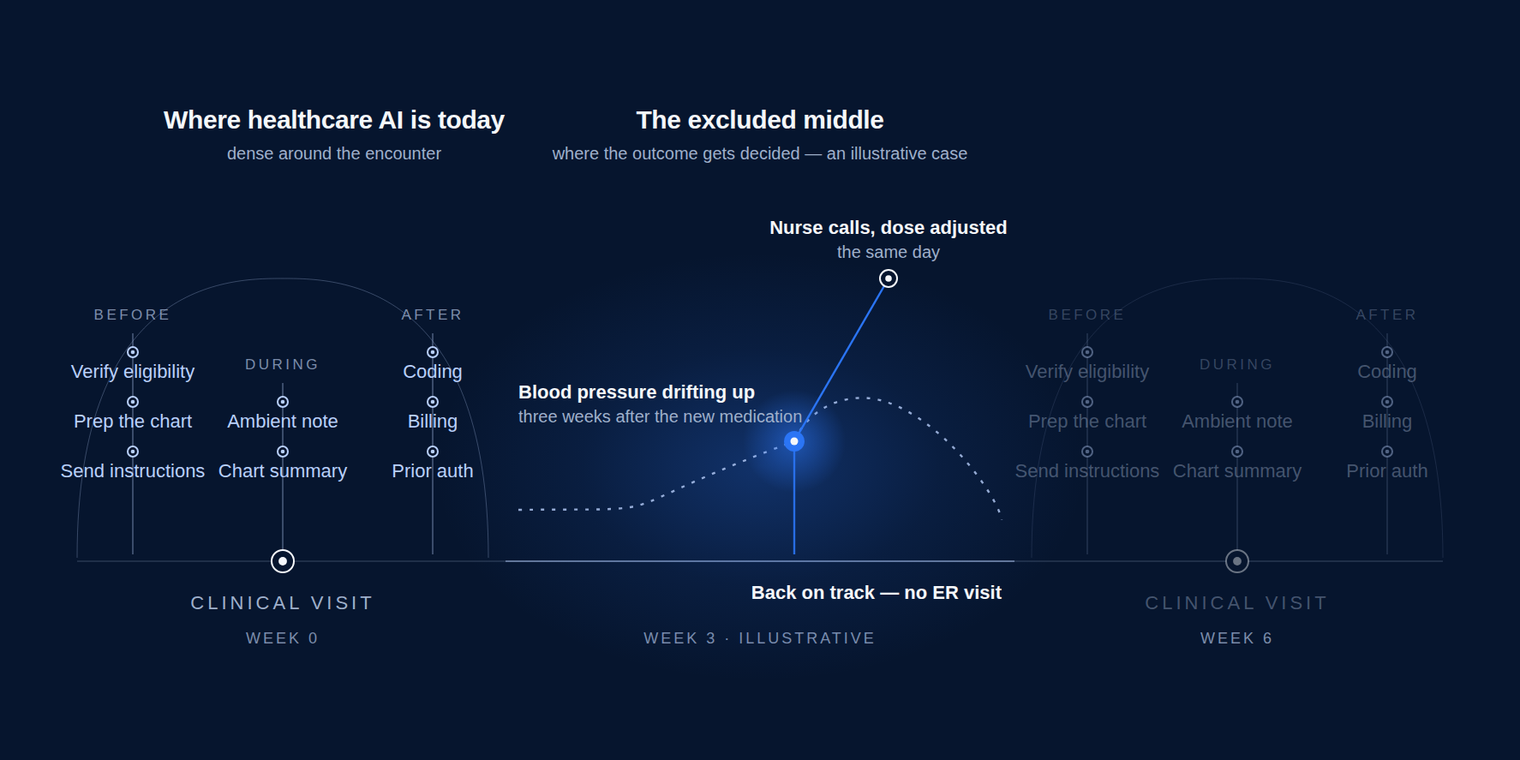
Healthcare AI is dense before, during and after the clinical encounter and thin in between. That excluded middle — continuous monitoring, escalation and software-guided intervention between visits — is where the largest healthcare AI companies of the next decade are likely to be built, by founders who start with a bounded workflow and design it to become continuous.
A surprisingly large part of healthcare runs on knowledge that does not exist in the electronic health record.
At one practice, the receptionist knows that Dr. Smith takes new patients only Monday, Wednesday and Friday, three to five. Somewhere else, a nurse knows which refill request can go straight to the physician and which one needs a lab first. Another office has a rule for fitting urgent patients into the schedule that lives in a Word document — or in the head of the person who has worked there for fifteen years. Sometimes it is literally on a Post-it note stuck to a monitor.
Confido Health, whose voice agents run across roughly 1,500 outpatient sites, describes its deployment process as finding exactly this kind of knowledge. Its engineers sit with receptionists, billers and office managers, watch how the practice actually operates, and translate that tribal knowledge into protocols software can execute. The company’s framing is that healthcare has spent two decades building systems of record — the EHR, the practice-management system, the billing system, the phone system — and what it lacked was a system of action that could work across them. [1]
That is a useful way to understand where healthcare AI is going, and it is why the most interesting question in the field is shifting from “what can the model say?” to “what work can the system complete?”
We wrote a field guide to where AI is working in healthcare today and what physician entrepreneurs should build. This piece is about what comes after — the part of medicine that AI has barely touched, and why it may be where the largest healthcare companies of the next decade come from.
AI is moving from answering to doing
Think of the progression in four stages. The economics change at each one.
AI understands. Summarize the chart. Search the literature. Draft the note. Pull the fax apart into fields. This is where the first wave lived, and it is where most of the published evidence sits.
AI assists. Prepare the refill request. Surface the relevant history. Flag the patients who need follow-up. Recommend the next operational step. A human still executes.
AI acts. Call the patient. Book the appointment. Verify eligibility. Send the preparation instructions. Follow a referral until it closes. This is the stage that crossed into budgeted purchase in 2026, and the phone is where it landed first. [1]
AI participates in care. Monitor what happens after treatment starts. Recognize that a patient may be deteriorating. Trigger a defined protocol. Escalate the right patient to the right clinician at the right moment.
The distinction matters because the business changes with each stage. A summarization tool saves time. An autonomous worker creates capacity. A clinical intervention system changes an outcome. Those become very different companies, with different buyers, different evidence bars and different ceilings.
Three levels of healthcare AI opportunity
Most of today’s companies sit at the first level. The next generation will be built at the third.
Remove work. Find something people already do constantly and make it disappear. Documentation, calls, scheduling, refill preparation, chart retrieval, prior authorization, coding. This is where the field guide lives, and it is where the fastest ROI is.
Create capacity. Find valuable work healthcare knows it should do but cannot afford to do consistently. Every referral followed to closure. Every care gap contacted. Every patient starting a high-risk medication checked again. Every no-show re-engaged. The instinctive AI business case is labor reduction; this is the bigger one. The question is not “what work could AI replace?” but “what valuable work would healthcare do if labor were suddenly abundant?”
Redesign care. Ask what healthcare would look like if intelligence and monitoring were always available. Longitudinal disease management. Deterioration detection. Software-guided interventions. Continuous post-treatment monitoring. Care models that are AI-native rather than AI-assisted.
The interesting opportunities often sit between the levels. A refill product becomes medication monitoring. A scheduling product becomes capacity optimization. A chart-summary product becomes longitudinal clinical intelligence. A call-center agent becomes care navigation. A care-gap agent becomes population-health infrastructure. The small workflow is the entry point. The larger company emerges when that workflow becomes continuous, intelligent and connected to the rest of care.
The next frontier is the excluded middle
There is substantial AI before the encounter, during it and after it. There is comparatively little that helps a clinician care for the patient in between.
Suchi Saria, the Johns Hopkins professor who founded Bayesian Health, points to an unusual asymmetry. Healthcare AI is now dense before the clinical encounter — preparing information, getting ready to see the patient. It is dense during the encounter, in documentation. And it is dense afterward, in coding, billing and structuring the record for reimbursement. What is comparatively thin is the middle: systems that directly help clinicians care for the patient between those points, and between visits. [2]
Her own work on sepsis is a map of what that middle demands. Turning an early-warning model into a product that changed care meant solving far more than prediction: prospective evaluation, workflow integration, clinician adoption, monitoring for drift, site-to-site generalization, regulatory clearance and a financial case that made adopting it, in her words, a “no brainer.” The retrospective model was the easy part. [2]
That journey is a warning against believing a high-performing model is a finished product. It is also the opportunity. Saria describes a potential third modality of medicine alongside drugs and devices: software- or AI-based interventional protocols that identify who needs attention, when they need it, and what action should follow. [2]
The first wave of healthcare AI removed work around the medicine. The next wave redesigns how the medicine gets delivered.
Imagine systems that continuously observe, detect meaningful change, initiate a defined workflow, escalate exceptions and measure outcomes.
- A cardiology system that watches the weeks after a medication change and escalates abnormal trajectories.
- An oncology system that identifies toxicity patterns between visits before they become emergency-department visits.
- A postpartum system that monitors symptoms and history after the obstetric episode has, on paper, ended.
- A refill system that knows when labs or an office visit are required before a renewal can move forward.
- A surgical system that identifies which patients are not following preparation instructions and intervenes before the case is canceled.
- A discharge product that tracks whether the next step in care actually happened.
Some of these should remain decision-support systems. Some will become regulated clinical products. The bar for evidence, oversight and autonomy should rise with the potential harm, and the sepsis story says exactly how much work that bar represents. But the direction is clear: AI is moving from helping healthcare document what happened toward helping healthcare decide what should happen next.
The opportunity may be much bigger than healthcare software
Most healthcare AI companies still look like software companies. That may only be the first generation.
Andreessen Horowitz has argued for years that the biggest company in the world could eventually be a consumer health technology company, on the simple arithmetic that U.S. healthcare is a multi-trillion-dollar industry several times larger than the advertising market that built today’s tech giants. [3] Julie Yoo later connected that thesis to AI: healthcare’s historically low software penetration, its labor intensity and its supply-demand mismatch — a system short more than a hundred thousand doctors and nurses — turn from liabilities into advantages once AI can scale clinical judgment beyond the clinicians we have. [4]
The firm’s more recent “infinite healthcare” argument makes the economic leap explicit. Healthcare is one of the few sectors where rising usage is treated as failure, because every additional encounter is expensive and clinician time is the scarce input. If AI lowers the marginal cost of knowledge, coordination and routine care, more healthcare no longer has to mean proportionally more cost — and the payment model built around clinician scarcity has to change with it. [5]
One of the largest AI companies in the world may ultimately be a healthcare company — not because healthcare became a technology market, but because AI changes how much healthcare we can economically deliver.
The eventual winner may not look like a software vendor at all. It may look like a new kind of healthcare system: continuous rather than episodic, proactive rather than reactive, able to serve far more people with the same scarce clinical expertise. That is why the opportunity for physicians is more inspiring than automating one annoying task. The small workflow is the wedge. The company is what happens when the workflow never stops.
What this means for physician entrepreneurs
Start in the first level. Design for the third.
None of this changes the advice in the field guide. Start with a workflow you have performed two thousand times. Find the step that requires judgment and protect it. Automate the six steps around it. Prove the result in ninety days. The companies that will matter in the excluded middle are being founded right now on unglamorous front-office and between-visit workflows, because that is where the data, the trust and the integrations get built.
What changes is the ambition you carry into it. When you pick the workflow, ask what it becomes if it runs continuously. When you build the harness — the context the model receives, the systems it can touch, the actions it may take, the exceptions that stop it — build it as if it will one day carry a clinical protocol, because the winners will. Rock Health’s read of the 2026 market is that the defensible companies own the workflow, the integrations and the deployment, not the model. [6] In the excluded middle, that is doubly true: the model is the cheapest part of a system that has to survive prospective evaluation, local variation and drift.
And carry the evidence discipline with you from day one. The field guide’s seventh trait — the product survives translation from benchmark to bedside — is optional at the first level and existential at the third. AUC is not adoption. Prediction is not intervention. The companies that redesign care will be the ones that treated that as the product from the start.
The question for physician entrepreneurs is changing. It is no longer “what can I build with AI?” It is “what do I understand about healthcare that most people building AI don’t?” Start there. Then ask the more ambitious question:
If AI could understand the information, use the software and take the routine actions, what care could we deliver that we simply cannot afford to deliver today?
That is where the next generation of healthcare AI companies comes from.
“The first wave of healthcare AI removed work around the medicine. The next wave redesigns how the medicine gets delivered.”
Questions this article answers
What is the excluded middle in healthcare AI?
The gap between clinical encounters. AI is now dense before a visit (preparation), during it (documentation) and after it (coding and billing), but comparatively little software helps clinicians care for a patient between those points — monitoring, detecting change, escalating and intervening. Suchi Saria of Bayesian Health describes this asymmetry and a potential third modality of medicine: software-based interventional protocols.
What comes after AI scribes and autonomous front-office agents?
Systems that participate in care: continuous monitoring after treatment starts, recognition of deterioration, defined protocols that trigger the next workflow, and escalation of the right patient to the right clinician. These products are harder because they require prospective evidence, clinical integration and sometimes regulatory clearance, but they may represent a much larger frontier.
Could a healthcare AI company become one of the largest companies in the world?
It is a thesis, not a forecast. Andreessen Horowitz has argued that the biggest company in the world could be a consumer health technology company, and that AI strengthens the case by lowering the marginal cost of knowledge, coordination and routine care while expanding how much healthcare the system can deliver.
How should a physician founder approach the excluded middle?
Start with a bounded workflow you know deeply, protect the step that requires judgment, automate the steps around it and prove the result in 30–90 days — then design the harness, integrations and evidence discipline as if the product will one day carry a clinical protocol. The wedge workflow is the entry point; the company emerges when the workflow becomes continuous.
Key takeaways
- Healthcare AI is progressing through four stages — understand, assist, act, participate in care — and the business changes at each one.
- Three levels of opportunity: remove work, create capacity, redesign care. Most companies sit at the first; the next generation will be built at the third.
- The excluded middle — care between visits — is where AI is thinnest and where the largest opportunity sits.
- The model is the cheapest part of a system that has to survive prospective evaluation, local variation and drift.
- Start in the first level, design for the third: pick the wedge workflow as if it will one day carry a clinical protocol.
Sources
- Raihan Faroqui, MD: The Doctor at the Front Desk, AI on the Line (Confido Health) — Practical AI in Healthcare (podcast), S2E1 — company-reported operating metrics (Primary data)
- Dr. Suchi Saria on Building AI That Changes Care — NEJM AI Grand Rounds (podcast) (Primary data)
- The Biggest Company in the World — Daisy Wolf and Vijay Pande, Andreessen Horowitz (Article)
- Why Will Healthcare Be the Industry That Benefits the Most from AI? — Julie Yoo, Andreessen Horowitz (Article)
- Infinite Healthcare: What’s It Worth? — Jay Rughani, Jane Rhee and Julie Yoo, Andreessen Horowitz (Article)
- H1 2026 Funding and Market Overview: Durable Roots, Shifting Routes — Rock Health (Report)
Building in healthcare AI?
Explore Health AI Launch →Keep reading
Related Insights
Working on something this article touches?
Work With DeepStart