Handle the Normal, Escalate the Exception: How Digital Workers Enter Healthcare
AI is moving from helping healthcare workers do tasks to completing bounded workflows. The opportunity is not replacing people — it is scaling labor, expertise and attention while humans keep the hard cases.
In brief
A digital worker owns a bounded healthcare workflow through completion: it understands the request, uses the systems it is allowed to use, takes permitted actions, confirms the task is done and escalates when the case falls outside its authority. What makes that safe is one architecture across labor, expertise and attention — handle the normal, detect the deviation, escalate the exception. Humans do not disappear; they stop being required for every normal case.
A patient calls a medical practice. “I need to move my appointment.” A chatbot can answer the question. A digital worker can identify the patient, open the scheduling system, apply the physician’s rules, find a valid slot, confirm it with the patient, update the schedule and close the loop. That sounds like a small difference. It is not.
For most of the current AI boom, software has been remarkably good at producing things: a note, a summary, an answer, a recommendation. The next generation is beginning to do things. Confido Health is the visible example in the front office: the company says its voice agents run across more than 1,500 healthcare locations, integrate with 40-plus EHR, practice-management and phone systems, and complete workflows from scheduling and refill routing to insurance verification, billing, referrals and recalls, handling about 70% of calls in some deployments. Those are company-reported figures, not independent clinical evidence. But they show the category has moved past the demo. [1]
Healthcare spent decades building systems of record — the EHR, the revenue-cycle system, the scheduling system, the payer portal, the phone system — and left humans responsible for carrying work between them. Digital workers are an attempt to build a system of action on top of those systems. Not an artificial doctor. Something less dramatic and potentially more consequential:
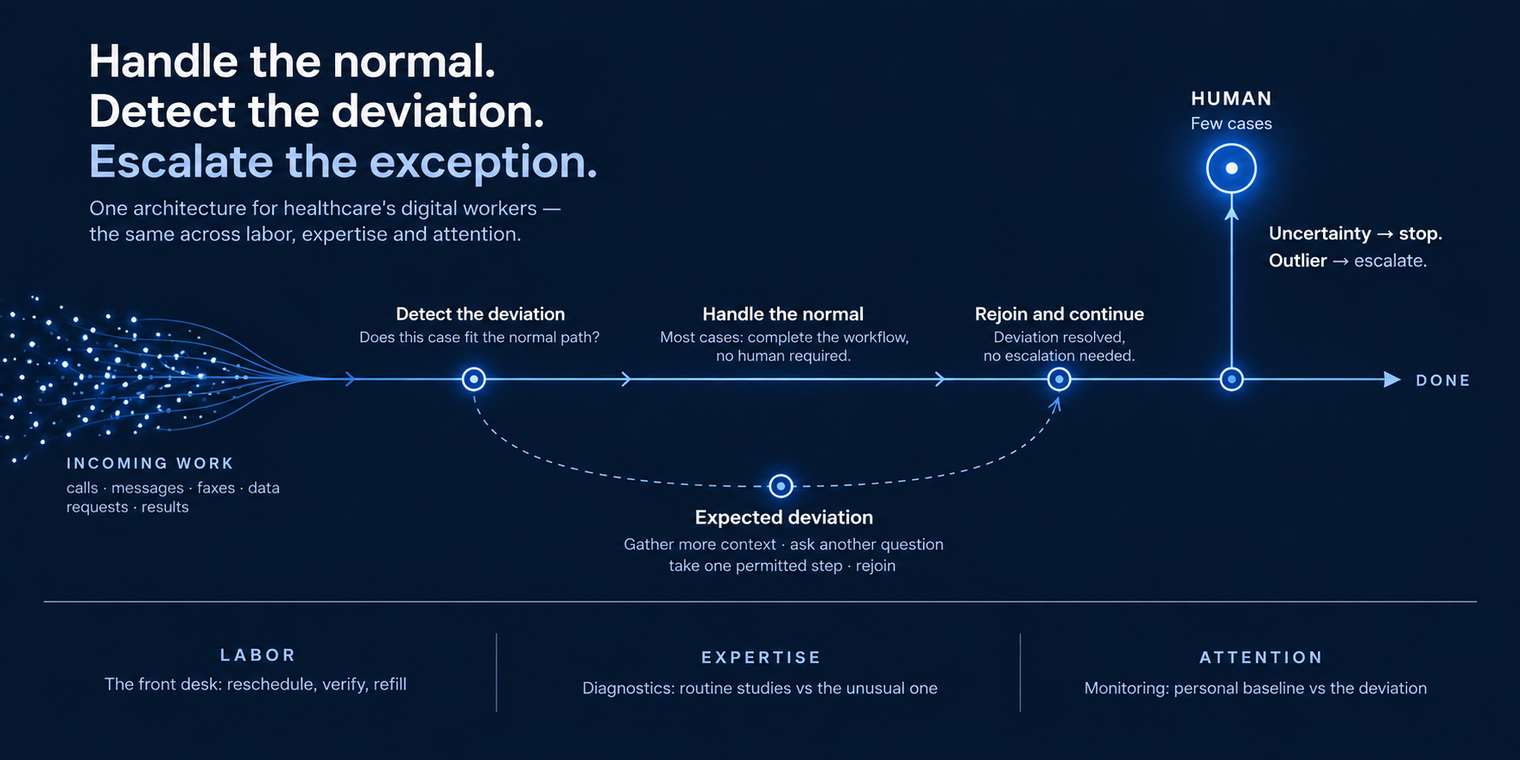
Handle the normal. Detect the deviation. Escalate the exception.
That may become the core architecture of healthcare’s digital workforce. This piece is about that architecture and the three kinds of leverage it creates. The field guide covers where AI is working today; the excluded middle covers where the next companies come from; the evidence ladder covers how to know whether any of it works. This one is about how autonomy should be built — and where it should stop.
What is a digital worker, and how is it different from a copilot or an agent?
The distinction that matters is how much of the work the software owns.
The terminology around agents has become loose enough to be nearly useless, so draw the line on ownership. A copilot helps a human perform a task: it summarizes a chart or drafts a note. An agent can take one or more actions: query a system, find an appointment, prepare an authorization. A digital worker owns a bounded workflow through completion: it understands the request, accesses the systems it is allowed to use, takes permitted actions, checks whether the task was completed, and escalates when the situation falls outside its authority.
Ownership implies a second property that is easy to miss: how well the system communicates with the people it works alongside. An escalation that arrives as a dropped call is a far worse product than one that arrives with the case assembled — what the worker tried, what it found, what it is uncertain about and what it recommends. Handing a colleague a half-finished problem with no context is not an escalation; it is an interruption. Escalating well is a design requirement, not an admission of failure.
The progression is: help with the task → perform the task → complete the workflow → own the outcome. Healthcare is already moving along that curve. The harder question is where autonomy works — and where it should stop.
What architecture makes autonomy usable in healthcare?
Neither “a human reviews everything” nor “the AI replaces the human” produces a useful system.
The naïve debate assumes two choices: either a professional inspects and approves every action, or the AI replaces the professional. Neither is right. If every routine action requires review, the scalability disappears. An autonomous system that cannot recognize its own limits is dangerous anywhere and especially in healthcare. The practical operating model is emerging in between:
- Normal case → complete the workflow.
- Expected deviation → gather more context or take a bounded action.
- Uncertainty → stop.
- Outlier → escalate to a human.
That same architecture appears across three very different kinds of leverage: labor, expertise and attention.
Labor leverage: why are the first digital workers in the front office?
The easiest jobs to automate are the least glamorous. That is why they are working.
Consider the medical front desk. A patient calls. Someone identifies the caller, understands the request, opens one or more systems, applies a set of practice rules, completes the action and communicates the result. Historically, more call volume meant more people. Digital workers change the unit of scale. Confido’s product is built around exactly this bounded, high-frequency work: scheduling and rescheduling, reminders, refill routing, insurance verification, billing questions, referral follow-up and recall campaigns. [1]
These workflows share five qualities that make them unusually well suited to autonomy: high frequency; a predictable normal path; several systems to cross; measurable completion; and an obvious handoff point when the normal path breaks. The buyer does not need to believe in artificial general intelligence. The buyer needs to believe that more calls will get answered, fewer tasks will sit in a queue, and staff will spend less time moving information between systems.
Revenue cycle is the obvious market
Revenue cycle is the least surprising digital-worker opportunity in healthcare: repetitive transactions, payer-specific rules, portals, faxes, claims, denials, and people moving information between systems. McKinsey estimates that up to 50% of healthcare administrative work can now be automated. Its more important point is that layering AI onto the old workflow does not produce the gain; organizations have to redesign the work. In revenue cycle, McKinsey points to routine activities such as payment posting and appeals management moving toward automation while humans focus on exceptions and complex payer interactions. [2] That is digital-worker architecture almost exactly: routine case to the machine, difficult payer interaction to the person. Revenue cycle will produce large companies. The category becomes more interesting when digital workers start amplifying scarce expertise.
Expertise leverage: will diagnostics become an exception business?
The framing “AI versus radiologist” misses the more important workforce change.
The FDA’s list of AI-enabled medical devices remains heavily concentrated in radiology, evidence that imaging is one of the most mature clinical-AI domains. [3] Machines are already capable at many high-volume, tightly defined pattern-recognition tasks. But medicine is not one clean probability distribution. There are ambiguous cases, rare diseases, conflicting signals, missing context, unexpected anatomy, a history that changes what an image means.
So the higher-value model is less “AI replaces the diagnostician” and more “AI processes more of the routine distribution while the diagnostician concentrates on uncertainty, exceptions and consequential cases.” Imagine a thousand screening studies. In an appropriately validated workflow, the system compares prior studies, quantifies change, ranks urgency, drafts structured observations, estimates its own uncertainty and flags the cases that do not behave like the normal population. The specialist’s attention shifts up the exception curve. That is not a claim that machines are universally better diagnosticians; they are not. It is a claim that the scarce expert becomes most valuable exactly where the machine is least certain.
The outlier is the most important feature
Healthcare technology has always obsessed over average accuracy. Necessary, not sufficient. A clinically meaningful autonomous system has to recognize insufficient data, contradictory information, low confidence, unfamiliar patterns, changing conditions and cases outside its validated operating envelope. The most important capability may not be knowing what to do; it may be knowing when not to. That is why “human in the loop” should not mean a physician clicking approve behind every output. The human should be pulled into the loop when the case warrants it — and the evidence ladder is how you find out whether a system can tell the difference.
The hard part is knowing which cases are the exceptions
That requirement is also the assumption the whole exception model rests on, and it is not a solved problem. A language model’s probability distribution over its next word is not a calibrated probability over clinical truth; a system can be fluent, confident and wrong in the same sentence. Healthcare compounds the difficulty, because the labelled outcome data needed to calibrate uncertainty well is scarce in most of the settings where these systems get deployed. Any honest version of this thesis has to carry that objection rather than route around it.
But the requirement is not that the model be self-aware. It is that the system around it can tell when a case has left the normal path — and that can be built from things other than the model’s own confidence: checks on whether the input resembles the population the system was validated on, disagreement between independent models, methods that produce a coverage guarantee rather than a belief, hard rules that stop on missing or contradictory data, and plain workflow signals such as a task that did not complete or a record that conflicts with itself. The sepsis alert described in the evidence ladder was not a language model, and its threshold earned trust by being evaluated prospectively against outcomes rather than by being theoretically calibrated. Knowing when to stop is an engineering and validation problem before it is a model problem.
Where the objection does bite is the economics. Imperfect separation between normal and exception does not break the model; it makes the system escalate more, and every escalation is a case a person has to absorb. That is a tax on the margin rather than a wall — but it means the exception rate is the unit economics of a digital worker. The share of work closed without a human is the P&L, and the quality of exception detection is the lever that moves it. Which gives a buyer two questions worth more than any accuracy number: what is your escalation rate, and how was that threshold validated? A company that cannot answer both is selling autonomy it has not measured.
The diagnostic opportunity does not end with the diagnosis
Imagine an incidental pulmonary nodule. The finding is one step. Someone still has to communicate the result, place the order, obtain authorization, schedule the follow-up, notice if the patient misses it, reschedule, obtain the next study and compare it with the prior image. A brilliant diagnostic model does little for the patient if the workflow stops at the report. The valuable digital worker may not merely find the abnormality. It makes sure the abnormality leads to the appropriate next action — which connects diagnostic AI to navigation, scheduling, prior authorization and longitudinal care.
Attention leverage: who watches the data nobody has time to watch?
Wearables solved continuous sensing. They did not solve continuous attention.
Healthcare has a third scarce resource that gets less discussion than labor or expertise: human attention. Wearables make the problem obvious. A 2026 JAMA Network Open analysis of nationally representative data on U.S. adults with cardiovascular disease or its risk factors found wearable use rising from 30.2% in 2020 to 41.1% in 2024 — while actual sharing of that data with clinicians stayed low, 14.2% in 2020 and 19.2% in 2024. [4] The technology can generate enormous quantities of data. The care system largely cannot consume it.
A physician does not need another dashboard of heart rate, sleep, activity, glucose, blood pressure, oxygen saturation, temperature and recovery scores. The clinician needs to know when something has happened that warrants human attention. The digital worker’s job is not to show clinicians more data. It is to make most of the data disappear.
A monitoring system that knows a patient’s baseline watches continuously. Most of the time nothing important happens, so nothing happens — that is a feature. Then a pattern changes. The system keeps monitoring, requests a symptom update, cross-checks medications, asks for another reading. If the deviation resolves, the clinician never sees it. If the trajectory becomes meaningfully unusual, the system escalates. The architecture becomes: continuous sensing → personal baseline → deviation → contextual interpretation → bounded action → outlier → human. Personal baseline matters as much as a population threshold; a resting heart rate can be normal for the population and abnormal for one person. That does not mean a wearable should diagnose disease from a deviation. It means longitudinal data becomes another input to the escalation decision. The dashboard reports the data. The worker decides whether the data deserves action.
Why is execution the missing bridge?
Context, judgment, execution. Most of healthcare AI still stops at the second.
The gap between intelligence and work is visible in one of the newest integrations. On September 1, 2026, OpenAI announced an Epic connection for eligible healthcare workspaces. It can review authorized patient information from Epic, but the connection is read-only: it cannot update records, place orders or message patients. [5][6] That boundary is instructive. Healthcare AI is moving through three layers — context (understand what happened), judgment (decide what matters) and execution (move an approved decision into the workflow). A wearable senses. An AI system increasingly understands. A digital worker appears when the system can safely carry the next step forward.
In many clinical workflows the near-term model will be: AI prepares the action, a human verifies and signs. Then, as evidence accumulates and workflows become better bounded, routine actions migrate toward autonomous execution while exceptions continue to escalate.
How will “human in the loop” evolve?
It can mean almost anything. A more useful progression has four stages.
- AI detects. The human reviews every result.
- AI interprets and prepares. The human verifies the proposed action.
- AI executes validated routine work. The human receives the exceptions.
- AI continuously manages a bounded pathway. The human manages uncertainty, outliers and consequential decisions.
The scaling mechanism is not that humans disappear. It is that humans stop being required for every normal case. And the evidence bar for moving from one stage to the next should rise with the consequence of being wrong — which is what the evidence ladder is for.
There is a compounding mechanism inside that progression, and it runs on the exceptions. Every escalation is a labelled example of where the boundary of the normal path actually sits — in this practice, with these patients, against this payer. A system that folds those cases back in, widening what it treats as normal as it learns which deviations were routine after all, improves without an engineer rewriting its rules for every change in the environment. That is what would let the architecture compound rather than plateau. It is also the honest answer to why encoding a practice’s tribal knowledge by hand does not scale: healthcare changes faster than anyone can re-encode it.
But learning is exactly where the evidence bar bites hardest. A system that changes its own behavior is also a system that can drift, and drift is what monitoring after deployment exists to catch: the American College of Radiology’s Assess-AI program is built to track how an algorithm performs locally once it is installed, against peer and national benchmarks. [7] So the rule holds, and it is the same rule. The higher the consequence of being wrong, the more the learning loop has to be observed and governed rather than automatic. In the front office it can move fast. Next to a clinical decision it has to be watched.
Why is task automation not enough?
Healthcare organizations can buy hundreds of agents and still fail to get more productive.
McKinsey notes that clinical-care labor productivity in the U.S. declined roughly 1% over two decades while productivity across the broader services economy rose more than 55%. Its argument is not that healthcare lacks technology; it is that technology has been inserted into old operating models instead of changing them. [2] That should change how builders think. The weak product helps the receptionist schedule faster; the larger product removes routine scheduling from the receptionist’s job. The weak product summarizes wearable data for a physician; the larger product shows the physician nothing unless something meaningfully changes. The weak product highlights an abnormal scan; the larger product makes sure the abnormality reaches the right person and the follow-up happens. That is the difference between automating a task and redesigning a workflow.
Three kinds of leverage, one architecture
Labor leverage: scheduling, calls, revenue cycle, prior authorization and repetitive administrative work. Expertise leverage: diagnostics and specialist workflows, where machines process routine volume and direct scarce experts toward ambiguity. Attention leverage: wearables, remote monitoring and longitudinal care, where software watches continuously so clinicians do not have to. The architecture underneath all three is the same. Handle the normal. Detect the deviation. Escalate the exception.
The radiologist sees the unusual study. The nurse sees the deteriorating patient. The pharmacist sees the abnormal medication response. The care manager sees the patient whose circumstances do not fit the pathway. The physician sees the case where the evidence conflicts, the story is unusual, or the cost of being wrong is too high. Software does not make those professionals less important. It makes their attention more valuable, because less of it is spent on routine work. Healthcare’s next workforce will not be human or digital. It will be both — and the defining question is no longer what jobs AI can perform.
What would healthcare become capable of if humans only had to do the work that requires humans?
A note on sources
Company-reported operating metrics are identified as such; clinical claims in this article are grounded in the cited sources.
“The scaling mechanism is not that humans disappear. It is that humans stop being required for every normal case.”
Questions this article answers
What is a digital worker in healthcare?
Software that owns a bounded workflow through completion: it understands a request, accesses the systems it is permitted to use, takes permitted actions, checks that the task was completed and escalates to a person when the situation falls outside its authority. A copilot helps a human do a task; an agent takes an action; a digital worker owns the outcome of a workflow.
What is the “handle the normal, detect the deviation, escalate the exception” architecture?
An operating model for safe autonomy: the normal case is completed automatically; an expected deviation triggers more context-gathering or a bounded action; uncertainty stops the system; an outlier is escalated to a human. It applies equally to front-office labor, diagnostic expertise and continuous monitoring.
Will AI replace radiologists and other diagnosticians?
The more likely change is that diagnostics becomes an exception business: validated systems process more of the routine distribution — comparing priors, quantifying change, ranking urgency, flagging cases that do not behave like the normal population — while scarce specialists concentrate on ambiguity, conflict and consequential cases. Machines are not universally better diagnosticians; the expert becomes most valuable where the machine is least certain.
How will human-in-the-loop evolve for healthcare AI?
Through four stages: AI detects and the human reviews everything; AI interprets and prepares and the human verifies the action; AI executes validated routine work and the human receives exceptions; AI continuously manages a bounded pathway and the human manages uncertainty, outliers and consequential decisions. The evidence required to move between stages should rise with the consequence of error.
Why does wearable data rarely change care?
Because wearables solved continuous sensing, not continuous attention. In a 2026 JAMA Network Open analysis of U.S. adults with cardiovascular disease or risk factors, wearable use rose from 30.2% to 41.1% between 2020 and 2024, but only 19.2% shared the data with clinicians. The job of a digital worker in monitoring is to make most of the data disappear and surface only the deviation that warrants human attention.
Can AI reliably tell which cases it should escalate to a human?
Not from its own confidence alone. A language model’s probability over its next word is not a calibrated probability over clinical truth, and healthcare has little of the labelled outcome data needed to calibrate it well. But exception detection can be engineered around the model — checks that the input resembles the validated population, disagreement between independent models, coverage-guarantee methods, hard stops on missing or contradictory data, and workflow signals. Imperfect detection raises the escalation rate rather than breaking the model, which is why the escalation rate and how its threshold was validated are the two questions a buyer should ask.
Key takeaways
- A digital worker is defined by ownership: it completes a bounded workflow and escalates the exception, unlike a copilot (helps) or an agent (acts).
- The usable operating model is neither review-everything nor replace-the-human: normal → complete; deviation → bounded action; uncertainty → stop; outlier → human.
- Three kinds of leverage — labor (front office, revenue cycle), expertise (diagnostics as an exception business) and attention (monitoring that makes most data disappear).
- Execution is the missing bridge: today’s newest EHR integrations are read-only, and the near-term model is “AI prepares, human signs.”
- Automating a task is not redesigning a workflow; the productivity gain comes from removing routine work from the job, not doing it faster.
Sources
- Conversational AI for Healthcare — product page and company-reported deployment metrics — Confido Health (company-reported) (Primary data)
- The real future of work in healthcare — McKinsey & Company (Report)
- Artificial Intelligence-Enabled Medical Devices (FDA list, updated periodically) — U.S. Food and Drug Administration (Report)
- Wearable Devices and Data Sharing in the US (adults with cardiovascular disease or risk factors) — Pedroso et al., JAMA Network Open (Study)
- Healthcare organizations can now connect EHR and additional industry data to ChatGPT — OpenAI (Article)
- Using the Epic plugin with ChatGPT and Codex (connection is read-only) — OpenAI Help Center (Primary data)
- Assess-AI — AI performance monitoring registry — American College of Radiology (Report)
Building in healthcare AI?
Explore Health AI Launch →Keep reading
Related Insights
Working on something this article touches?
Work With DeepStart