Where AI Is Actually Working in Healthcare — and What Physician Entrepreneurs Should Build
Ambient documentation, patient access, chart intelligence and autonomous front-office work are producing measurable results in real practices. The pattern behind the wins is where physicians should look next.
In brief
Healthcare AI works where it removes the work around the medicine: ambient documentation, patient access, chart intelligence and, increasingly, software that completes bounded front-office workflows end to end. Physician entrepreneurs should start by asking where healthcare still does valuable work badly, why — and whether the product can survive translation from benchmark to bedside.
Updated September 2026 with new evidence on autonomous front-office work, deployment, and why benchmark performance is not clinical usefulness.
Healthcare AI has moved well beyond the demo stage. The money certainly has. AI-enabled startups took 54% of the $14.2 billion invested in U.S. digital health in 2025, and by mid-2026 Rock Health had stopped treating AI as a category worth separating out because, in its words, AI has become “table stakes.” [1][2] Physicians aren’t on the sidelines either: 81% now say they use AI professionally, up from 38% in 2023, according to the American Medical Association’s 2026 survey of roughly 1,700 physicians. [3]
Something else has changed since the first wave. Ambient scribes are no longer the only category with a budget line. In our conversations with health-system and practice buyers this year, the question has shifted from “does AI work?” to “how much of our problem can you take?” — and the answers cluster around voice AI for inbound and outbound patient work, revenue cycle and prior authorization, process automation, patient navigation and pharmacy operations. Rock Health’s mid-year read shows the same pattern: revenue cycle is where consolidation ran hottest, and the best-capitalized infrastructure companies have made forward-deployed engineers part of how they sell. [2]
Money, adoption and ambition are no longer the constraint. The more useful question is what is actually working, because healthcare has a way of humbling technology. A model can look extraordinary in a benchmark and still fail in a real practice. It can’t get the data it needs. It doesn’t fit the workflow. Clinicians don’t trust it. It saves three minutes and creates five somewhere else. Or everyone loves it and nobody has budget to buy it.
For physicians thinking about becoming founders — physician entrepreneurs, or “doctorpreneurs” as many now call themselves — this is where it gets interesting, because doctors have an advantage that is hard to manufacture: they live inside the problems. The patient who can’t get an appointment even though capacity exists somewhere in the system. The referral that disappears between two organizations. The physician reconstructing a patient’s story from years of fragmented records while the patient waits.
That fragmentation is measurable. In 2023, 70% of U.S. hospitals could at least sometimes send, receive, find and integrate outside health information, but only 43% did all four routinely. And even where outside records were routinely available electronically (71% of hospitals), only 42% reported clinicians routinely using them when treating patients. [4] Healthcare has made real digital progress. It also still runs on phone calls, faxes, portals, manual data entry, and humans acting as the integration layer between systems.
AI is arriving directly into that gap. It is answering patient calls, filling schedules, documenting visits, summarizing charts, supporting coding and revenue-cycle work, and — through more than a thousand FDA-authorized AI-enabled devices, most of them in radiology — assisting with clinical decisions. [5] Even the foundation-model companies have moved in: OpenAI launched OpenAI for Healthcare in January 2026 with UCSF, Cedars-Sinai, Boston Children’s, Memorial Sloan Kettering and HCA Healthcare among its first customers. [6]
But clinical insight alone doesn’t make a company. A systematic review of clinical AI development found that in 82% of design studies clinicians were consulted only late in the design cycle, and in just 22% were they involved throughout — a pattern the authors tied directly to why tools fail at the bedside. [7] The reverse failure is just as common: a problem can be clinically infuriating without being economically important, and a pilot can produce impressive results without ever becoming a business.
The opportunity sits at the intersection of four things: a real healthcare problem, a workflow AI can materially improve, value that can be measured, and a product people can actually deploy. So instead of asking “what can AI do in healthcare?”, start with a better question: where is healthcare still doing valuable work badly — and why?
Where should physician entrepreneurs look for AI opportunities?
Start with the work, not the technology. The best healthcare AI ideas come from workflows that already consume expensive time and produce measurable waste.
The fastest way to find a bad healthcare AI idea is to start with AI. Healthcare is full of workflows nobody would design today: they accumulated over decades of reimbursement rules, regulation, staffing constraints, acquisitions, EHR implementations and workarounds layered on workarounds. Eventually the workaround becomes the workflow.
Consider prior authorization. The AMA’s most recent survey found physicians complete an average of 40 prior authorizations per week, consuming about 13 hours of physician and staff time, and 40% of physicians employ staff who work exclusively on it. [8] Thirteen hours a week, for one workflow. Then there is everything else: refills, results, patient messages, scheduling, referrals, documentation, coding, claims, records requests, and finding information buried somewhere in the chart.
This is where physicians have an unusual advantage. A technologist can interview a physician about a workflow. A physician has performed it 2,000 times. They know why the oncologist does it differently from the dermatologist, which shortcut the nurse actually uses, which alert gets ignored, which step can’t safely be automated — and which three steps everyone wishes would disappear.
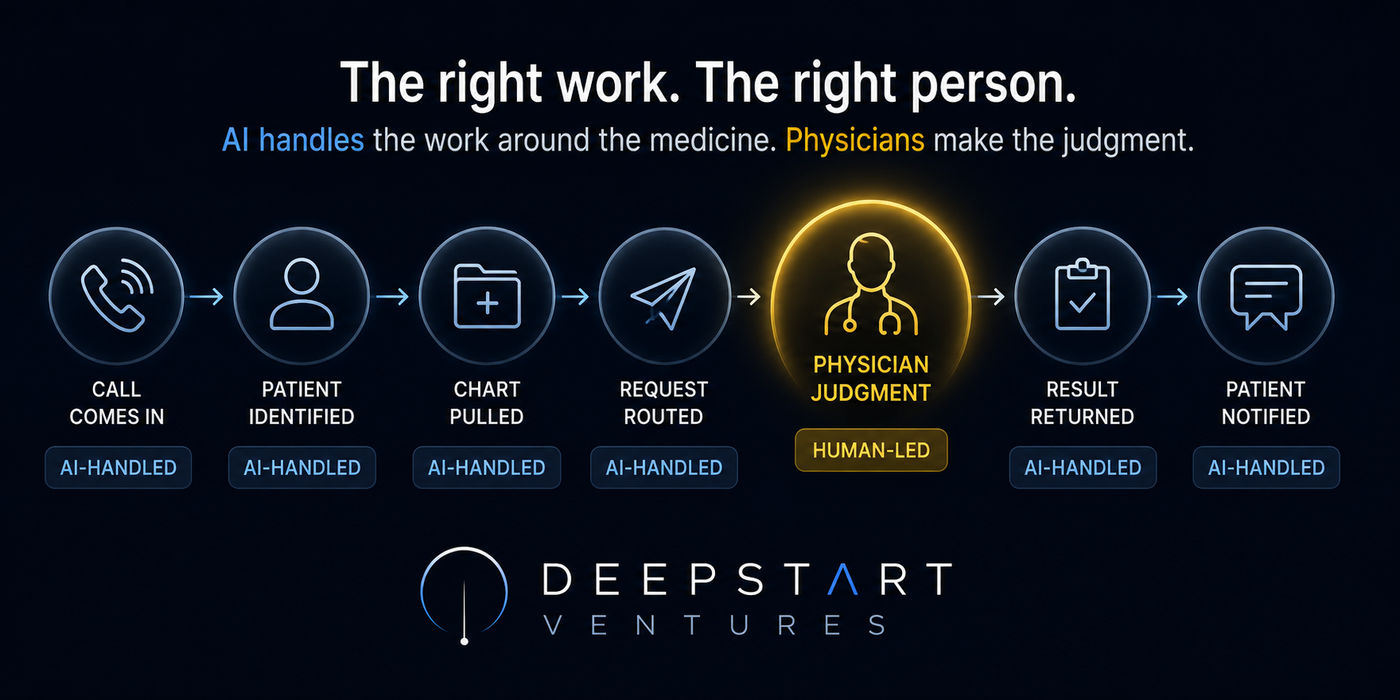
Take something as ordinary as a prescription refill. Walk through it honestly and it’s a seven-to-nine-minute workflow. A patient calls. Someone identifies the patient and the medication, pulls the medication history from the EHR, checks the last visit and any relevant labs, applies the practice’s rules, prepares the request and routes it. The physician makes the decision. Then the outcome has to make its way back to the patient and the pharmacy.
There is an important clinical decision in the middle of that workflow. But how much of everything surrounding it actually requires a physician — or even a human? That is a far more interesting question than “can AI prescribe medication?” Some of the biggest opportunities in healthcare AI may not come from automating medicine at all. They may come from automating the enormous amount of work required to make medicine happen.
Once you look at healthcare this way, familiar problems change shape. A missed appointment isn’t a scheduling problem; it’s clinical capacity that disappears forever. An unanswered call may be a patient who never gets into the practice. Ten minutes reconstructing a history is expensive clinical time spent finding context instead of using it. A denied claim is care that was delivered but hasn’t been paid for. A referral sitting in a queue may be a patient’s care journey coming to a stop. And prior authorization isn’t just administrative burden — it’s a capacity problem hiding inside an administrative workflow.
Something to do this week: pick one workflow your practice runs more than 50 times a day and time it end to end. Note who touches it, what system they touch, and which single step actually required judgment. Most physicians have never done this for their own practice, and it is the cheapest market research available.
Where is AI actually working in healthcare right now?
The strongest evidence today is in ambient documentation, patient access and scheduling, chart intelligence and — the newest category — autonomous front-office work. In every case AI removes work surrounding the encounter rather than replacing clinical judgment.
Ambient documentation is the clearest example, and the evidence is now multicenter and at scale. In a 2025 JAMA Network Open study of 263 ambulatory clinicians across six U.S. health systems, 30 days of ambient AI scribe use was associated with burnout falling from 51.9% to 38.8%, alongside improvements in after-hours documentation, cognitive load and attention to patients. [9] A single-system quality-improvement study at Penn Medicine (46 clinicians, 17 specialties) found 20.4% less time on notes per appointment and 30% less after-hours documentation per workday. [10] And Kaiser Permanente’s Northern California group has now published on 7,260 physicians and roughly 2.5 million encounters over 15 months, with nearly 16,000 documentation hours saved and 88% of surveyed physicians reporting a positive impact on visit interactions. [11]
Notice why the product works. The physician still practices medicine. The AI takes away work surrounding the encounter. Notice, too, the honest read of the Kaiser numbers: 16,000 hours across 2.5 million encounters is a modest per-visit saving. The value physicians describe is as much cognitive — less mental workload, better recall of the visit, more attention on the patient — as it is minutes. That distinction matters when you write your ROI slide.
Patient access and scheduling is where the economics are easiest to see. For a practice, an empty appointment is perishable inventory. Operators of large physician groups have compared each slot to an airline seat: once the plane leaves, the seat can never be sold. The physician, staff, exam room and infrastructure are all there at 10:30. Once 10:30 passes, that capacity and its revenue are gone.
The progression we’re seeing in practices is telling: answer the call, book the appointment, then predict which patients are likely to cancel or no-show and schedule around that risk. The first step is automation. The later steps are intelligence, and they lead somewhere more interesting than “AI scheduling” — into how a healthcare organization allocates scarce clinical capacity. The same lens applies to operating rooms, imaging slots, infusion chairs and specialist appointments. These aren’t automatically startup ideas, but perishable capacity is a signal worth watching because its value can be measured.
There is a second lesson in scheduling. In our conversations with multi-site specialty groups, the first message to a new AI vendor is often some version of “do not touch our schedules.” Individual physicians have very specific ways they want their days structured, and an algorithm can produce a mathematically more efficient schedule and still make the practice worse. Hold that thought; we come back to it below.
Autonomous front-office work is the newest category to cross from pilot into purchase, and it changes what “AI in the practice” means. The first generation of tools helped a human do a task faster. This generation completes a bounded task itself: it understands the request, uses the practice’s own systems, and closes the loop.
The concrete case is the phone. Confido Health, whose voice agents now run across roughly 1,500 outpatient sites, handles appointment management, refill requests, insurance verification, billing questions and pre- and post-procedure instructions, in twenty languages. The company reports that its agents take about 70% of inbound calls at customer practices — by design, since clinical questions and anything outside a trained protocol transfer to a person — and that the practices it sells into miss 25–40% of calls before deployment, 7–15% even with a call center. Roughly half of those calls are patients trying to book a visit and about one in ten are refill requests, which is how a missed-call rate turns into missed revenue. Those are company-reported figures and should be read that way, but the buyers’ scorecard is telling: nobody is measuring “AI.” They are measuring missed-call rate, appointments recovered, staff time returned to the front desk, and patient satisfaction. [12]
It is also telling who bought first. Roughly a third of Confido’s customers are dental groups and another third are ophthalmology practices and surgery centers — consumer-facing, often cash-pay specialties where the phone is the front line of the business. The practices that already ran like consumer businesses were the first to pay for software that answers the phone. Follow the work, and follow the money.
Think back to the refill. What made it a seven-to-nine-minute workflow was not the decision; it was the six steps around the decision. Bounded autonomous work is the product category that takes those six steps. A patient says “I need to move my appointment,” and the system has to identify the patient, understand the request, know this practice’s scheduling rules, inspect the calendars, find an acceptable slot, confirm it and write the change back to the underlying system. That is not a chatbot. It is a workflow — and it is why “voice AI” is the wrong name for the category.
The voice is the interface. The product is completion.
Chart intelligence is the theme to watch most closely, because it is emerging from the bottom up. In the AMA’s 2026 survey, 28% of physicians reported using AI to generate chart summaries and 39% to summarize research and standards of care — ahead of assistive diagnosis at 17%. [3] Physicians are reaching for tools that help them understand a patient faster, and in some organizations tools built for coding or documentation integrity are being used as chart-navigation tools because the AI-generated view of the patient is easier to work with than the chart itself.
Think about how large that problem is. A patient’s story is scattered across years of notes, labs, imaging, medications, specialist visits, hospitalizations, outside records and, increasingly, data generated outside the health system. The information exists. The context often doesn’t. Assembling the right information at the moment a human has to decide may prove to be one of the most important themes in healthcare AI — and the ONC data above says the raw material is already sitting in the system, largely unused.
Is the ROI of healthcare AI about cutting headcount?
Increasingly, no. The strongest business cases are about capacity: doing valuable work that practices want done but cannot currently staff.
There is a tendency to frame AI ROI around headcount. Operators are already showing why that’s too narrow. What practices describe wanting is capacity — work they know they should be doing but can’t staff: answer every patient call, follow up every referral, close every care gap, work every appropriate denial, keep the schedule full.
In that world, the ROI of AI isn’t doing the same work with fewer people. It’s doing work that wasn’t economically possible before. Confido’s own account of what customers buy is the cleanest statement of it we’ve heard: nobody buys AI; they buy patient access, recovered revenue, staff capacity and margin. And the receptionists whose calls the agents absorb end up greeting the patient at the door and walking them to the room, not off the payroll. [12] The strongest pitch is rarely “we reduce this department from 20 people to 15.” It’s “answer the calls you currently miss,” “recover the appointment capacity you’re losing,” or “follow through on every referral.” Those outcomes are easier to understand, measure and sell than “AI transformation.”
There is a structural reason agentic products are getting bought, and founders should understand it because it is how the buyer thinks. Traditional health IT sold against the IT budget, which in most organizations is small and already spoken for. A product that demonstrably performs labor can be evaluated against the labor or operating budget instead — a far larger pool, and the one every practice owner is watching as margins compress. That doesn’t make the sale easy. Procurement, security review and integration are as slow as ever. But it changes the size of the economic problem you are allowed to solve.
Something to do this week: list the three things your practice would do tomorrow if it had two more full-time staff. That list is a product roadmap.
What do the healthcare AI use cases that work have in common?
Seven traits show up repeatedly: the problem already exists, it happens constantly, the outcome is measurable, the AI fits the existing workflow, humans stay where judgment matters, trust is built into the product — and the product survives translation from benchmark to bedside.
Put scheduling, ambient documentation, chart intelligence, refills, prior authorization, revenue cycle and diagnostics next to one another and they look like different markets. Underneath, the ones that work share a structure.
The problem already exists. AI didn’t create the pain; people are already spending money, time or clinical capacity on it. A founder shouldn’t have to spend half the sales meeting convincing a physician the problem is real.
The workflow happens constantly. A problem that happens 50 times a day can be worth more than an extraordinary problem that happens twice a year. Saving two minutes on something done 100 times a day is not a two-minute problem.
The outcome can be measured. Calls answered, appointments filled, documentation minutes reduced, claims collected, denials overturned, refills processed, physician time returned, diagnostic performance improved. If you can’t define “better” before deployment, you can’t prove ROI after it.
AI fits into the workflow instead of creating another one. Healthcare does not need another portal. The closer AI sits to the systems, data and workflows people already use, the less behavior it has to change. Rock Health’s H1 2026 read of the market is blunt on this point: the question investors now ask is not “who has AI?” but “who has something AI alone can’t provide?” — and their answer centers on workflow ownership, integrations, and hands-on deployment. [2]
What “hands-on deployment” means in practice is worth spelling out, because it is where the real product lives. A surprising amount of healthcare runs on rules that exist nowhere in the EHR. Dr. Smith sees new patients only Monday, Wednesday and Friday, three to five. This refill can go straight to the physician; that one needs a lab first. Confido describes sending forward-deployed engineers to sit beside receptionists, billers and office managers, watch how the practice actually operates, and turn that tribal knowledge — some of it in a Word document, some of it on a Post-it note stuck to the monitor — into protocols the agents are trained on. [12] This is the resolution to “do not touch our schedules.” The founder’s job is to be opinionated enough to improve the workflow and flexible enough to encode each practice’s exceptions — too rigid and physicians won’t use it, too customizable and you’re building a different product for every customer.
The model is rarely the hardest part. Mapping the Post-it notes is.
Humans remain where judgment matters. The refill example works precisely because the physician stays responsible for the clinical decision while AI handles the work around it. The right question isn’t “can we automate the entire workflow?” It’s “which parts require human judgment — and why are humans still doing the rest?”
Trust is part of the product. Physicians need to know where information came from. Organizations need visibility into what agents are doing. Clinical systems need appropriate validation. Patient-facing systems need escalation paths. And the consequences of an error determine how much autonomy the AI should have — the closer a system moves toward making or executing consequential decisions, the higher the bar. What that looks like operationally: Confido defines a failure as any action outside the agent’s trained protocol, whether or not it was harmful, runs a second set of monitoring agents over every conversation to flag those, and retrains and redeploys when they occur. The company reports that its off-protocol rate fell from 5–10% at launch to 1–2% under that regime. [12] Treat the number as company-reported; treat the process as the point. A supervisor listening to recorded calls and coaching the receptionist is exactly what a practice already does with people.
It survives translation. AUC is not adoption, and prediction is not intervention. The clearest warning comes from Suchi Saria, the Johns Hopkins professor who built the sepsis early-warning system behind Bayesian Health, describing what it took to get from a published model to a product that changed care. Retrospective accuracy did not predict prospective usefulness. A model trained on ICU data did not transfer cleanly to the emergency department or the floor. Ground truth was noisy. And the most instructive failure: models learned to detect the physician’s response — the lactate order, the antibiotics — rather than the disease, so they flagged sepsis after the clinician had already acted, which is exactly when an alert is worth nothing. Practice patterns drift, and correlations learned last year quietly break. [13]
Getting past that required prospective evaluation, workflow integration, transparency about why the model fired, monitoring for drift, site-to-site generalization, ongoing maintenance, clinician adoption, evidence of outcomes and a financial case — until, in Saria’s phrase, adopting it was a “no brainer” for a health system. [13] That list is the seventh trait. A high-performing model is the entry ticket. The product is what happens when it has to identify the right patient early enough to change care, survive local variation, and keep performing as medicine changes around it.
What should a physician entrepreneur build?
Probably not “an AI healthcare company.” Whether you call yourself a physician entrepreneur or a doctorpreneur, start with a problem you know unusually well, then test it against seven questions.
For the next few weeks, don’t brainstorm startup ideas. Keep a problem ledger. Every time something frustrates you, your staff or a patient, write it down. Then look for patterns: where does someone repeatedly copy information from one system into another? Where does a patient wait because nobody has time to respond? Where does the same request arrive 50 times a day? Where does a highly trained person do work that requires very little of their training? Where does money disappear because a workflow broke? And, most importantly, what valuable work isn’t happening at all because nobody has capacity to do it?
Then run each candidate through seven questions.
- How often does it happen? Daily beats quarterly.
- Who does the work today? Physician, nurse, MA, front desk, coder, patient? The more expensive or constrained the person doing low-value work, the more interesting the problem.
- What happens if the work isn’t done? Care delayed, revenue lost, patient leaves, physician time wasted, risk increased?
- Does the information needed already exist — and where? The EHR, a PDF, a fax, a phone call, an image, a payer portal, five different systems? Fragmentation itself can be the opportunity.
- What part actually requires judgment? Protect that part. Question everything around it.
- Can you measure the result within 30–90 days? If you can’t demonstrate value inside a pilot, selling the product gets substantially harder.
- Can it survive the real workflow? Not the demo. The 4:45 p.m. Friday workflow, the impatient physician, the messy chart, the specialty exception, the EHR integration, the patient who says something unexpected, the nurse who has done the job for 15 years. That is the real product.
One question you probably don’t need on the list: “should I train my own medical model?” A few years ago, building a medical AI company usually implied training or fine-tuning a specialized model. That is becoming less central. Karan Singhal, who leads health AI at OpenAI and previously worked on Google’s Med-PaLM, describes three layers of specialization — specialized models, specialized training and specialized harnesses, meaning the prompts, tools, sources, context and permitted actions wrapped around a model — and notes that modern general models increasingly absorb specialized health training without losing their general reasoning. [14]
For a physician founder the implication is practical, not philosophical. Defensibility rarely comes from owning a different model. It comes from the harness: what clinical context the model receives, which systems it can use, what action follows, which exceptions stop the workflow, and where a human must step in. Confido, for what it’s worth, runs on the same frontier models everyone else can rent; what it says it owns is the specialty-specific tuning built from millions of minutes of practice calls and the protocols mapped on site. [12] Every one of those is a question a physician can answer better than the people currently building most of the products.
The model is increasingly available to everyone. The workflow is not.
Why physicians have an edge in healthcare AI
AI is lowering the cost of building software. It is not lowering the cost of understanding healthcare, and that makes clinical insight more valuable, not less. If almost anyone can build a prototype, the advantage shifts to knowing what deserves to be built, where it belongs in the workflow, what data it needs, where the risk lies, how clinicians will actually use it, and who will pay for the outcome.
Investors are saying this out loud. Rock Health’s H1 2026 report notes that “founders with deep experience inside the healthcare organizations they’re selling to often have a clearer view of where the most meaningful (and solvable) problems exist.” [2] Physicians already possess that view. The work is learning to look at the everyday environment differently — the empty slot, the missing context, the portal everyone hates, the task done 50 times a day, the two hours of work after the last patient leaves. Those aren’t merely frustrations. Some are signals. And as AI gets better at understanding information, operating software and taking actions, some of those signals are becoming companies that weren’t practical to build a few years ago.
The question for physician entrepreneurs — for every doctorpreneur weighing a first company — isn’t “what can I build with AI?” It’s “what do I understand about healthcare that most people building AI don’t?”
Start there.
“Some of the biggest opportunities in healthcare AI may not come from automating medicine at all — but from automating the work required to make medicine happen.”
Questions this article answers
Where is AI actually working in healthcare right now?
The strongest evidence is in ambient documentation (multicenter studies show burnout falling from 51.9% to 38.8% after 30 days of AI scribe use), patient access and scheduling, chart intelligence (28% of physicians already use AI for chart summaries), and a newer category of autonomous front-office agents that complete bounded workflows such as appointment changes, refill requests and insurance verification. In each case AI removes work surrounding the encounter rather than replacing clinical judgment.
What healthcare AI startup should a doctorpreneur build?
Not “an AI healthcare company.” Start with a workflow you know unusually well, keep a problem ledger for a few weeks, and test each candidate against seven questions: how often it happens, who does the work today, what happens if it isn’t done, whether the information already exists, which part truly requires judgment, whether the result is measurable within 30–90 days, and whether it survives the real 4:45 p.m. Friday workflow. The best doctorpreneur ideas automate the work around the medicine, not the medicine itself.
Is the ROI of healthcare AI about cutting headcount?
Increasingly, no. Practices describe wanting capacity — answering every call, following up every referral, closing every care gap, working every appropriate denial — work they could never staff. The strongest healthcare AI business cases are about doing valuable work that wasn’t economically possible before, not doing the same work with fewer people.
Why do healthcare AI models that perform well in studies fail in practice?
Because retrospective accuracy is not prospective usefulness. Models can learn signals that appear only after a clinician has already acted, fail to transfer between care settings, and degrade as practice patterns drift. Products that work add prospective evaluation, workflow integration, drift monitoring and evidence of outcomes on top of the model — and that translation work, not the model, is usually the product.
Do physician entrepreneurs need to build their own medical AI model?
Usually not. Capable general models can be combined with specialized training, tools, clinical context, integrations and workflow-specific software. For most companies the surrounding harness and workflow are more defensible than owning a unique foundation model.
Key takeaways
- The biggest healthcare AI wins automate the work around the medicine, not the medicine itself.
- The newest category to cross into budgeted purchase is bounded autonomous work — software that understands a request, uses the practice’s systems and completes the workflow.
- The strongest ROI story is capacity, not headcount: doing valuable work practices could never staff.
- Winning use cases share a structure: the problem already exists, happens constantly, is measurable, fits the workflow, keeps humans where judgment matters — and survives translation from benchmark to bedside.
- Physicians’ edge is knowing what deserves to be built — start with a problem ledger, not a brainstorm.
Sources
- 2025 Year-End Digital Health Funding Report: $14.2B, 54% to AI-enabled startups — Rock Health (via Fierce Healthcare) (Report)
- H1 2026 Funding and Market Overview: Durable Roots, Shifting Routes — Rock Health (Report)
- More than 80% of physicians use AI professionally: AMA survey (81% in 2026 vs. 38% in 2023) — American Medical Association (Report)
- Interoperable Exchange of Patient Health Information Among U.S. Hospitals: 2023 — ONC / ASTP (HHS), Data Brief No. 71 (Report)
- Artificial Intelligence-Enabled Medical Devices (FDA list, updated periodically) — U.S. Food and Drug Administration (Report)
- Introducing OpenAI for Healthcare — OpenAI (Article)
- Inclusion of Clinicians in the Development and Evaluation of Clinical AI Tools: A Systematic Review — Tulk Jesso S, et al. Frontiers in Psychology (Study)
- 2025 AMA Prior Authorization Physician Survey (40 PAs/week; 13 hours/week) — American Medical Association (Report)
- Use of Ambient AI Scribes to Reduce Administrative Burden and Professional Burnout: A Multicenter QI Study — Olson KD, et al. JAMA Network Open (Study)
- Clinician Experiences With Ambient Scribe Technology to Assist With Documentation Burden and Efficiency — Duggan MJ, et al. JAMA Network Open (Penn Medicine) (Study)
- Ambient Artificial Intelligence Scribes: Learnings after 1 Year and over 2.5 Million Uses — Tierney AA, Liu VX, et al. NEJM Catalyst (Kaiser Permanente) (Study)
- Raihan Faroqui, MD: The Doctor at the Front Desk, AI on the Line (Confido Health) — Practical AI in Healthcare (podcast), S2E1 — company-reported operating metrics (Primary data)
- Dr. Suchi Saria on Building AI That Changes Care — NEJM AI Grand Rounds (podcast) (Primary data)
- OpenAI's Karan Singhal on HealthBench and the Future of Medical AI — NEJM AI Grand Rounds (podcast) (Primary data)
Building in healthcare AI?
Explore Health AI Launch →Keep reading
Related Insights
Working on something this article touches?
Work With DeepStart