Women’s Health Doesn’t Have a Demand Problem. It Has a Buyer Problem.
Prescriptions are surging, capital is back and a $1 billion company is expanding. So why did a Y Combinator-backed perimenopause startup shut down? Because need and a business model are not the same thing.
In brief
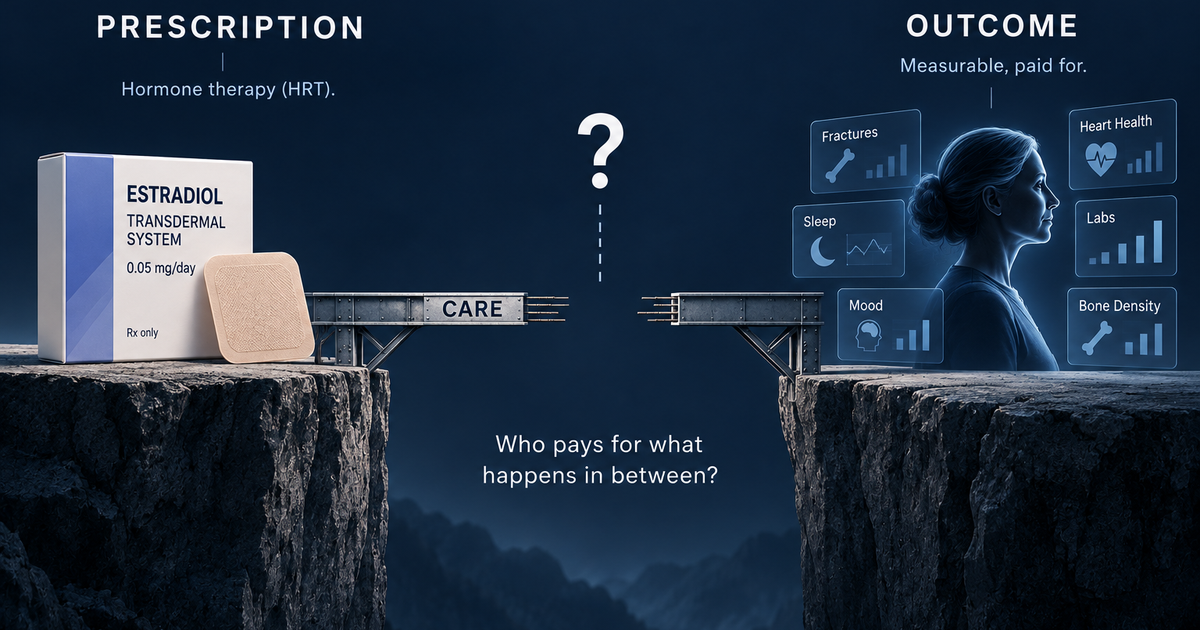
Women’s health is not short of demand: hormone-therapy prescribing has more than doubled since 2018, a menopause clinic reached a $1 billion valuation and the FDA has loosened labels. Play Health still shut down because no one with a budget had an economic reason to pay for the care layer around the prescription. Companies win by naming the buyer, the payment trigger and the outcome early — not by proving the need again.
On Sept. 9, 2026, Play Health’s perimenopause platform went dark. The Boulder, Colo., company, backed by Y Combinator, said its patient app and clinician dashboard would be permanently unavailable after that date, and that account data would be deleted rather than transferred or sold.
That would be an unremarkable footnote if menopause care were struggling for attention. It is not. Hormone-therapy prescribing has more than doubled since 2018. Consumer-health companies that built their businesses around categories such as hair loss and weight loss have moved into menopause. Midi Health, a menopause-first virtual clinic, raised $100 million in February 2026 at a $1 billion valuation. The Food and Drug Administration has begun removing long-standing boxed-warning language from menopausal hormone-therapy labels. And the FDA has said patients are having difficulty obtaining estradiol patches as demand rises.
And yet a company built specifically to improve perimenopause care could not find a sustainable way to get paid for it.
Play’s co-founder and chief executive, Andrea Mazzocchi, put the problem plainly when she announced the wind-down in August. The company was built as a data-driven preventive-care resource meant to help patients and clinicians manage menopause together. It could not find a place in either cash-pay or insurance-covered healthcare. Improved menopause care, she wrote, continued to be treated as a “nice to have.”
That is Play’s own account of it. The mechanism underneath is not specific to Play. A prescription has a billing code; the care around it does not. Nothing in fee-for-service pays for managing symptoms between visits. No single organization owns the outcome for a midlife woman whose care is split across a gynecologist, a primary-care physician, an employer benefit and a health plan. Employer midlife-health budgets exist but are small and slow to buy. And what a consumer will pay for a symptom tracker sits well below what clinical-grade longitudinal infrastructure costs to build and keep running. Play was selling something real to people who wanted it, into a market with no budget line for it.
It is tempting to file that under the familiar story of how hard it is to build in women’s health.
We think it points to something larger, and more useful.
Women’s health does not have a demand problem. It has a buyer problem.
Across the category, products exist with a clear user, a clear need and often clear clinical value, but no equally clear economic buyer. A woman may want the product badly. Her physician may believe it improves care. Her employer may agree it matters. An investor may believe the category should be enormous.
None of that, on its own, makes a market.
A market becomes commercial when someone with a budget has an economic reason to pay for the outcome.
Menopause has become one of the clearest places to watch that gap open.
A market forming faster than a care system
The demand story is hard to dispute.
Truveta, which analyzes de-identified electronic-health-record data from U.S. health systems, reported in April 2026 that prescribing of estrogen-based hormone therapy rose 104.8% between January 2018 and February 2026. Among women 45 to 54, the increase was 184.2%. By February, 49 of every 1,000 women in that age group with prescription records had evidence of an estrogen prescription — roughly one in 20.
The acceleration is recent. Estrogen prescribing rose 19.1% across all age groups in the seven months between July 2025 and February 2026, while prescribing among women 45 to 54 rose 25.7%. Truveta notes that these are preliminary, non-peer-reviewed findings and that some prescriptions may have been for indications other than menopause.
Progesterone-containing therapy has moved faster still. In a follow-up analysis published in June 2026, Truveta reported that prescribing among women 45 to 54 increased 488% between 2018 and May 2026, reaching 30 prescriptions per 1,000 women.
The regulatory environment shifted underneath those numbers.
On Nov. 10, 2025, the FDA began the process of removing boxed-warning statements concerning cardiovascular disease, breast cancer and probable dementia from menopausal hormone therapies. On Feb. 12, 2026, it approved revised labels for an initial six products. Other warnings, including the endometrial-cancer warning on certain estrogen-alone systemic products, remain.
Demand has outrun supply for at least one formulation. On Sept. 3, 2026, the FDA said patients have had difficulty obtaining their usual estradiol transdermal patches, that it is working with all six manufacturers to increase availability, and that rising demand followed, in part, greater interest in hormone therapy after its recent labeling changes. It has not declared a formal shortage.
So the question is no longer whether women will seek menopause care.
They are seeking it, in numbers the system did not plan for.
The question is whether healthcare has built anything around that demand besides the prescription itself.
Reporting from Wales in September 2026 suggests what happens when it has not.
Menopausal women who could not obtain testosterone through the National Health Service have been posing as men to buy it from online pharmacies. Dr. Michelle Olver, a menopause consultant, described a “very sharp increase” in referrals and said she had seen women with testosterone levels up to 12 times the safe level after obtaining the drug outside normal clinical monitoring, putting them at risk of permanent side effects.
That reads as an access story.
It is also a care-design story.
When testosterone is appropriate, the clinical process is not “obtain testosterone.” It is patient selection, baseline testing, dosing, follow-up labs, monitoring for adverse effects and a judgment about whether treatment is working.
When the formal pathway is hard and the consumer pathway is easy, the market solves access faster than healthcare solves care.
The prescription gets easier to buy. The care around it gets more important — and no easier to fund.
That distinction is the heart of the Play Health story.
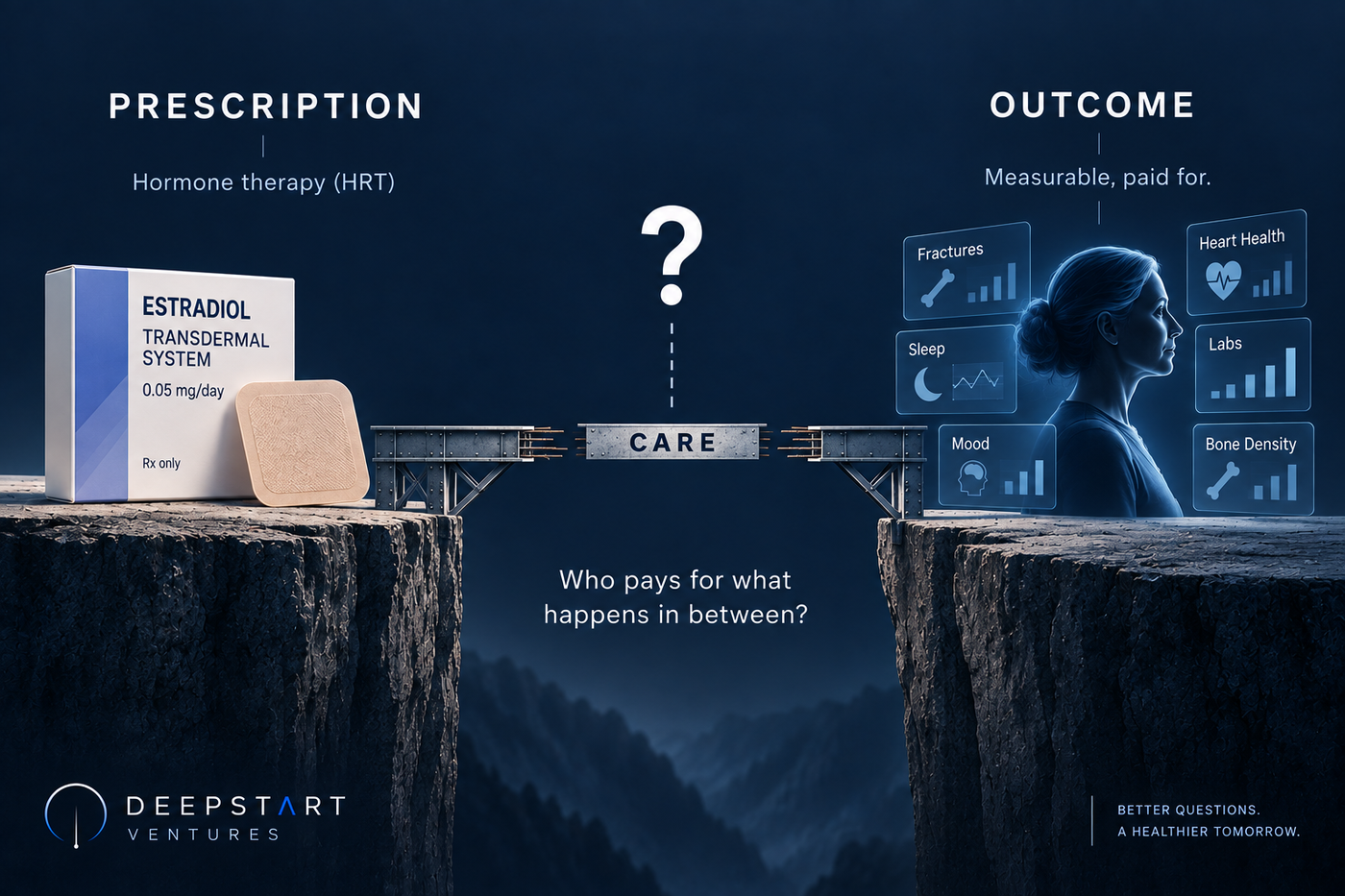
A prescription has a buyer. Care is harder.
A prescription fits neatly into healthcare’s existing commercial architecture.
A patient has symptoms. A clinician evaluates her. A drug is prescribed. The patient or her insurer pays for the visit and medication.
Every party knows its role and its budget line.
The care surrounding that prescription is not so tidy.
Good midlife care can involve symptom interpretation, sleep, mental health, bone health, metabolic risk, sexual and urogenital health, medication adjustment, longitudinal monitoring and the recurring judgment about whether something labeled “menopause” is actually a problem that belongs in cardiology, neurology, endocrinology or behavioral health.
Economically, responsibility fragments.
Who pays to make a primary-care physician materially better at treating menopause? Who pays for symptom tracking between visits? Who pays to connect wearable data, lab results, medication history and patient-reported symptoms into one record? Who pays for monitoring after the prescription is written?
Those are not rhetorical questions. Medicare's closest equivalent to a between-visit management benefit, chronic care management, requires a patient to have two or more chronic conditions expected to last at least 12 months or until death, placing her at significant risk of death, acute exacerbation or decompensation, or functional decline. Those are, in CMS's description, the only diagnostic criteria. A woman moving through the menopausal transition does not meet them. There is no code for managing her.
Play Health was trying to build precisely that connective layer. Its platform integrated personalized symptom, medication and lifestyle data, generated AI-powered insights for providers and accumulated a longitudinal dataset with every clinical interaction.
That is potentially valuable.
Play simply could not find a sustainable reimbursement or cash-pay model for it.
Menopause has successfully become a prescription category. It has not yet consistently become a funded care category.
A market can have booming drug demand and struggling care businesses at the same time. This one does.
The missing product sits between the prescription and the outcome
There is an obvious product inside that gap, and it is not another telehealth clinic writing HRT prescriptions.
Today a woman may get her hormone therapy from one clinician, her labs somewhere else, her sleep and recovery data from a wearable, her symptom history in an app, and then return months later to an appointment where much of that context has to be reconstructed.
The missing product is the longitudinal infrastructure around hormone therapy and midlife health: one continuous record running from symptoms through medications, labs, treatment changes, side effects, wearable signals, risk factors and clinician decisions to outcomes.
That is the same gap we have described in healthcare AI from the other direction — the excluded middle, where software is dense before, during and after the clinical encounter and thin in between, which is where the outcome actually gets decided. Menopause is that gap with a hormone prescription attached.
Software, and increasingly AI, can make that record useful rather than merely larger.
It can flag meaningful change between visits. Surface when follow-up testing is due. Prepare a concise longitudinal summary before an appointment. Help identify when something requires clinician review. And, over time, help answer the question much of healthcare still struggles to answer: is the intervention actually improving the outcomes that matter?
The consumer benefit is continuity. The clinician benefit is better information at the point of decision.
But the commercial question is the one running through this whole piece: who captures enough of that value to pay for it?
For a women’s-health clinic, the answer might be clinician capacity, safer management and patient retention. For a health system, it might be keeping the midlife woman’s broader care relationship rather than losing her to a dozen point solutions. For a payer, the bar is higher: show that better longitudinal management changes measurable outcomes or utilization. For the consumer, the product has to solve something painful enough to sustain direct payment.
That is a very different starting point from “let’s build a menopause app.”
The opportunity may be to build the care operating layer between prescription and outcome — and then prove which economic buyer benefits enough to fund it.
The biology is bigger than gynecology
The case for that layer gets stronger the further one looks from the reproductive system.
Healthcare organizes women’s health around reproductive events: fertility, pregnancy, menopause. Female physiology does not respect those boundaries.
Asthma is one example. The disease shows well-established sex differences, and researchers continue to investigate how hormonal changes interact with asthma across puberty, menstruation, pregnancy and menopause.
Yet even where women are well represented in research, sex-specific analysis remains surprisingly thin.
The National Academies reached that conclusion in its 2025 review of women’s health research at the National Institutes of Health. Closing the gaps in how conditions “disproportionately affect, present in, and progress differently in women,” it found, requires sex to be built into research design, analysis and reporting — not just into who gets enrolled. It also found that NIH funding for women’s health research has been flat for a decade and has fallen as a share of the agency’s overall spending.
Nobody thinks of asthma primarily as a women’s-health category. Female biology plainly matters to it.
The same broader question is surfacing in neuroscience.
A paper published in September 2026 in Scientific Reports examined a brain-targeted approach to hormone treatment for cognitive symptoms in menopause. Its human treatment data involved only 20 women and should be read as preliminary. The more durable idea sits underneath the experiment: menopause affects multiple organ systems — brain, bone, cardiovascular, metabolic, urogenital, and potentially other disease pathways influenced by the hormonal transition — raising the possibility that future approaches become more targeted rather than treating menopause as one homogeneous condition.
Healthcare sees menopause as a specialty. Biology sees it as a system-wide transition.
If that is right, midlife may be more valuable as a risk-management and engagement window than as a symptom category alone.
Not because hormone therapy should be sold as a longevity drug. It should not.
But because this is a stretch of years when a woman is often already engaging with the healthcare system while multiple health trajectories may be changing.
That also happens to be where the economics become clearer.
A payer may have no budget line labeled “better menopause experience.” It already spends on fractures, behavioral health, metabolic disease, cardiovascular events, respiratory admissions, medication management and avoidable utilization.
The commercialization question becomes concrete: What measurable outcome changes? How quickly can it be shown? Who bears the cost of doing nothing? And who captures the benefit of intervening?
That is how an important health problem becomes a fundable healthcare product.
The buyer is often already in the building
Two acquisitions in 2026 show where some of those buyers already exist.
In June 2026, Aeroflow Health acquired Canopie, a digital preventive-care platform focused on maternal mental health and physical wellness.
Aeroflow already had something Canopie did not need to build from scratch: distribution, patient relationships and reimbursement infrastructure. Its maternal-health business reaches about 1.7 million expecting and new mothers each year through products and services including breast pumps, lactation support and perinatal education.
Aeroflow had invested in Canopie in 2022 after the companies collaborated on integrating mental-health and lactation support. In announcing the acquisition, it explicitly said the combined company would deepen health-plan and government relationships by demonstrating maternal-health outcomes and the cost savings that follow.
Canopie added care to infrastructure Aeroflow already owned.
Nine days earlier, WPS acquired Mavida Health, a digital mental-health company providing therapy, psychiatry and medication management across reproductive and hormonal transitions including PMDD, fertility, pregnancy loss, postpartum and menopause.
WPS already operates health-insurance and benefits infrastructure. It described the acquisition as part of a broader revenue-diversification strategy and the first in a series of targeted investments and acquisitions it is evaluating.
Neither deal means every women’s-health startup should build to be bought by an insurer or a DME company.
The lesson is broader. The strongest economic buyer may be the organization that already owns reimbursement, distribution, covered lives or a durable relationship with the patient.
That should shape company design far earlier than the exit.
Midi shows the other path
Midi Health is attacking the buyer problem from the opposite direction. Rather than attaching itself to someone else’s rails, it is widening the value of the patient relationship it built around menopause.
Midi raised $100 million in February 2026 at a $1 billion valuation and said the next phase would scale a comprehensive healthcare platform for women across life stages.
That expansion runs on existing rails. Midi's care is insurance-covered, and it now delivers through health-system partnerships including Keck Medicine of USC and Mount Sinai. The wedge was menopause. The economics were reimbursement from the start.
That is strategically important.
Menopause is the wedge. The longitudinal relationship is the platform.
A single symptom category can produce a transaction. A continuing clinical relationship can support multiple reimbursable encounters, additional specialties, care coordination and more opportunities to demonstrate measurable outcomes.
Play and Midi therefore offer a useful contrast. Play built a care layer and struggled to find where it should be paid for. Midi built around reimbursable clinical care and is expanding outward from the patient relationship.
Different products, different economics, different answers to the same buyer problem.
The buyer gap is bigger than menopause
This is why Play Health matters beyond its own category.
Women’s health is full of markets where the person with the problem and the organization that benefits economically from solving it are not the same.
Postpartum care is a stark example. The mother’s need can be acute, yet much of the system’s attention shifts to the child once the obstetric episode closes. Her employer may absorb productivity consequences. A payer may absorb downstream mental-health and medical claims. Primary care may not see her for months.
The patient has the problem. The economic consequences are scattered. Nobody clearly owns the outcome.
Unless someone gathers them.
Pomelo Care raised $92 million in January 2026, led by Stripes, at a $1.7 billion valuation. The valuation is not the interesting number. Pomelo contracts with health plans and employers covering more than 25 million lives across commercial and Medicaid arrangements, and says it now supports nearly 7% of all U.S. births. It reports a 37% reduction in preterm births, 6.8 fewer NICU days, 46% lower emergency-room utilization and a three-to-five-times return for its customers through reductions in total cost of care.
Those are the company's own figures. The structure behind them is what matters.
Pomelo did not persuade anyone that maternal health is important. It went to the organizations already absorbing the cost of that care going badly, and sold them the reduction.
The consequences were scattered until a company made itself the place they collect. That is the postpartum buyer problem solved in the only way it can be — not by inventing a budget, but by proving whose existing budget moves.
Fertility has a different architecture. Pain and urgency support substantial direct spending, while employer and insurance benefits have created identifiable budgets. Maternal DME has reimbursement embedded in the category. Prescription businesses have a recognizable transaction. Diagnostics can attach to a clinical decision with an existing payment pathway.
Calling all of that “women’s health” is useful clinically and culturally. Commercially, it can be misleading.
A more useful map would start with four questions: Who owns the budget? What event triggers payment? What outcome creates economic value? How long does it take to prove it?
That map looks nothing like the standard chart of fertility, maternal health, menopause and sexual health. It may be far more predictive of which companies become durable businesses.
The funding-gap story is no longer enough
For years the sector has, rightly, called attention to how little capital it receives. The argument still matters. It is becoming a weaker explanation for which companies survive.
Silicon Valley Bank estimates that $2 billion of venture capital went into women’s-health companies across the U.S. and Europe in 2025 and counts $6.2 billion invested since 2019 in companies addressing conditions unique to women. AI-enabled women’s-health companies had a median pre-money valuation of $35 million in SVB’s analysis — roughly three times their non-AI peers.
Capital is entering. Demand is rising. Consumers are paying. Prescriptions are surging. Companies still fail.
Capital can finance the search for product-market fit. It cannot manufacture an economic buyer after the fact.
The next phase of women’s health may therefore be less about proving the problems are real and more about connecting those problems to healthcare economics.
That does not mean building backward from a payer spreadsheet. The best companies will still start with the woman: What is broken? What hurts? What does the existing system fail to do?
But commercialization has to enter the conversation earlier than it usually does.
A prediction, so this can be judged later
If the argument here is right, it implies something specific enough to be wrong. The first durable menopause care company — the one still standing in five years earning real margin on the care layer rather than on the prescription — will not be a standalone app a woman pays for out of pocket. It will be built inside, or bought by, an organization that already owns covered lives, reimbursement or a durable clinical relationship: a health system, a payer, an employer benefits platform, or a virtual clinic that has widened far enough beyond menopause to become one. Aeroflow buying Canopie, WPS buying Mavida and Midi expanding out of menopause into acute and postpartum care are three different expressions of the same gravity.
That prediction can lose, which is the point of making it. Here is how you would know. If a midlife-health company is still independent in 2031 — still not billing insurance, not selling through employers or health systems, still charging women directly for ongoing management rather than for prescriptions, labs or devices — then the buyer problem is a smaller constraint than we think and this piece was wrong. That is the test.
The nearest thing to a counterexample is already funded. It is worth saying why it is not one.
Clair Health raised $11.6 million in June 2026, backed by Khosla Ventures, to build a wrist-worn wearable that infers estrogen, progesterone, LH and FSH from biosensor signals rather than blood, with a consumer launch planned for November 2026 and more than 25,000 people on a waitlist.
That is a real attempt at part of the layer this piece says is missing — continuous hormonal signal in place of episodic testing, sold straight to the woman, in exactly the channel Play could not make pay.
It still would not prove the prediction wrong, and the reason is the useful part.
Measurement is not care. Oura and Whoop built durable businesses on physiological signal, and neither settled anything about whether longitudinal care can be sold direct. Clair may become the best hormonal sensor on the market and remain a hardware-and-subscription company — a good business, and a different one.
So the test needs a sharper edge than it had a paragraph ago. Proving this wrong takes a standalone company earning durable margin on the interpretation and the management: the record, the judgment about what changed, the follow-up that gets prompted, the accountability for the outcome. Paid for by the woman herself. Not a sensor. Not a subscription to data. The work between the signal and the outcome.
Clair's more likely path, if the technology delivers, is the one this piece already predicts. The signal becomes accurate enough to change a dose, a follow-up interval or a referral — and at that moment it stops being a consumer product and becomes an input to a reimbursable decision, with a buyer Play never had access to.
A hormone wearable that starts selling to clinics, health systems and virtual menopause practices is not evidence against the prediction. It is the prediction happening.
There is a third outcome, and it may be the likeliest of all.
The care layer never becomes a line item anywhere. Not sold to women, not sold to payers — absorbed. A clinic that bills encounters has every reason to build longitudinal tracking and no reason to charge for it, because the tracking is what brings the patient back. In that version the layer is real, valuable and everywhere, and it never appears as revenue. It is cost of retention.
That would not make the argument here wrong. It is the argument arriving quietly: the layer gets funded out of margin earned somewhere else, by companies that had a reimbursable business first.
Which means the sharper claim is not that someone finally sells the care layer. It is that nobody does. They sell the encounter, the covered life or the device — and give the layer away to protect them.
Build for the beneficiary. Design for the buyer.
Before scaling, every women’s-health company should be able to answer three questions.
Who has the problem? Not “women.” Which woman, at what moment, trying to accomplish what that the system currently makes hard?
Who benefits economically when it is solved? Whose medical cost falls? Whose revenue rises? Whose clinician capacity improves? Whose retention increases? Whose risk declines?
What existing budget pays for that outcome? An insurance claim? An employer benefit? A hospital operating budget? A pharmaceutical commercial budget? DME reimbursement? The consumer’s wallet?
If there is no existing budget, the company may still be right. But it is attempting two innovations at once: changing care and creating a new economic category. That is substantially harder — and it is worth knowing on day one.
Play Health is worth studying precisely because the need did not disappear when the business model failed. If anything, the opposite is happening.
More women are seeking treatment. Some are routing around fragmented systems to get it. The science increasingly suggests that female biology reaches well beyond reproductive medicine. And established healthcare organizations are buying specialized women’s-health capabilities when those capabilities plug into infrastructure that already gets paid.
The market is moving. The care system is catching up.
And between the prescription and the outcome sits one of the most important unbuilt layers in the category: infrastructure that makes treatment longitudinal, measurable and connected to the rest of a woman’s health.
The next generation of women’s-health companies will not win simply by building products women deserve. They will win by connecting those products to outcomes someone in healthcare already has an economic reason — and an existing budget — to improve.
“Capital can finance the search for product-market fit. It cannot manufacture an economic buyer after the fact.”
Questions this article answers
Why did Play Health shut down if demand for menopause care is rising?
Play Health built a care layer — symptom tracking, medication monitoring and AI-generated insights between visits — and could not find a place for it in either cash-pay or insurance-covered healthcare. Its CEO said improved menopause care is still treated as a "nice to have." Demand for hormone therapy was surging at the same time; what was missing was a buyer with a budget for the care around the prescription.
What is the difference between a demand problem and a buyer problem in women's health?
A demand problem means women don't want or use the product. A buyer problem means they do, but no organization with a budget has an economic reason to pay for the outcome. Much of women's health has clear users, clear need and clinical value, yet the payer, employer or health system that benefits is not the one being asked to pay.
How much has hormone therapy prescribing increased?
Truveta reports that estrogen-based hormone therapy prescribing rose 104.8% between January 2018 and February 2026, and 184.2% among women 45 to 54. Progesterone-containing therapy prescribing among women 45 to 54 rose 488% between 2018 and May 2026. The FDA removed boxed warnings about cardiovascular disease, breast cancer and probable dementia beginning in November 2025 and now reports patients having difficulty obtaining estradiol patches.
Who are the natural buyers of women's-health companies?
Organizations that already own reimbursement, distribution, covered lives or a durable patient relationship. In 2026, Aeroflow Health (a maternal DME company reaching 1.7 million mothers a year) acquired Canopie, and the insurer WPS acquired Mavida Health. Pomelo Care took the same logic further, contracting directly with health plans and employers covering more than 25 million lives and selling maternal outcomes as a reduction in total cost of care. Each attached specialized care to economic infrastructure that already got paid.
What should a women's-health founder answer before scaling?
Three questions: Who has the problem — which woman, at what moment? Who benefits economically when it is solved — whose cost falls, whose revenue or capacity rises? And what existing budget pays for that outcome — an insurance claim, an employer benefit, a hospital budget, DME reimbursement or the consumer's wallet? If no budget exists, the company is attempting two innovations at once: changing care and creating a new economic category.
What is the biggest unbuilt product in menopause care?
The longitudinal infrastructure between the prescription and the outcome: one continuous record connecting symptoms, medications, labs, treatment changes, wearable signals and clinician decisions, with software that flags meaningful change, prompts follow-up testing and shows whether treatment is improving outcomes. The open question is which economic buyer — clinic, health system, payer or consumer — captures enough value to fund it. It may never be sold separately at all: the likeliest outcome is that a company already billing for encounters builds it and gives it away to keep the patient.
Key takeaways
- A market becomes commercial when someone with a budget has an economic reason to pay for the outcome — need, clinical value and investor enthusiasm are not enough.
- Menopause has become a prescription category but not yet a funded care category, which is how drug demand can boom while care businesses fail.
- The missing product sits between the prescription and the outcome — and it may never be sold as a product at all, but absorbed as cost of retention by companies that already bill for something else.
- The strongest buyer is usually the organization that already owns reimbursement, distribution or covered lives, and that should shape company design long before the exit.
- Before scaling, answer three questions: who has the problem, who benefits economically when it is solved, and what existing budget pays for that outcome.
Sources
- Play Health shutdown notice: platform permanently unavailable as of Sept. 9, 2026 — Play Health (Primary data)
- Play Health company profile (Y Combinator, Fall 2025 batch) — Y Combinator (Primary data)
- Perimenopause Platform Play Health Shuts Down — Femtech Insider (Article)
- Estrogen-based hormone replacement therapy use is rising — Truveta Research (Primary data)
- Progesterone-containing hormone replacement therapy use is rising — Truveta Research (Primary data)
- HHS Advances Women’s Health, Removes Misleading FDA Warnings on Hormone Replacement Therapy — U.S. Food and Drug Administration (Primary data)
- Menopausal Hormone Therapies with Updated Prescribing Information — U.S. Food and Drug Administration (Primary data)
- FDA Update on Estradiol Transdermal Patch Availability — U.S. Food and Drug Administration (Primary data)
- Women pose as men to buy testosterone online after prescription difficulties — FemTech World (Article)
- A New Vision for Women’s Health Research: Transformative Change at the National Institutes of Health — National Academies of Sciences, Engineering, and Medicine (Report)
- Targeting hormone treatment for the brain in menopause — Scientific Reports (Study)
- Aeroflow Health Acquires Canopie to Close the Maternal Care Gap for Millions of New Mothers — Aeroflow Health via GlobeNewswire (Primary data)
- WPS Announces Acquisition of Mavida Health, Expanding Digital Mental Health Capabilities for Women and Families — WPS via PR Newswire (Primary data)
- This $1 Billion Health Startup Is Expanding Beyond Menopause — Inc. (Article)
- Innovation in Women’s Health Investment Report 2026 — Silicon Valley Bank (Report)
- Pomelo Care Raises $92 Million Series C, Reaches $1.7 Billion Valuation, to Expand Its Proven Model Beyond Maternity — Pomelo Care via PR Newswire (Primary data)
- Clair Health Raises $11.6 Million to Develop Continuous Hormone Monitoring Wearable — HLTH (Article)
- Midi Health: insurance-covered care and health-system partnerships — Midi Health (Primary data)
- Chronic Care Management Toolkit: eligibility criteria for CCM services — Centers for Medicare & Medicaid Services (Primary data)
This is what we back.
Explore Back →Keep reading
Related Insights
Working on something this article touches?
Work With DeepStart