Stop Renting Your Intelligence
Model access is getting cheaper and less differentiating. What's getting scarcer is the loop that makes your system better than anyone else's.
In brief
Frontier model access is becoming abundant and open weights are collapsing the price, so the model itself is no longer where differentiation lives. What compounds is the loop around it: your production data, your experts' corrections, your evaluations, and the real-world outcomes that feed the next training run. Rent intelligence early, own your evaluation next, optimise economics when cost turns material, and own the loop only when AI is genuinely why customers choose you.
Anyscale showed a table at Ray Summit last week that I have not stopped thinking about.
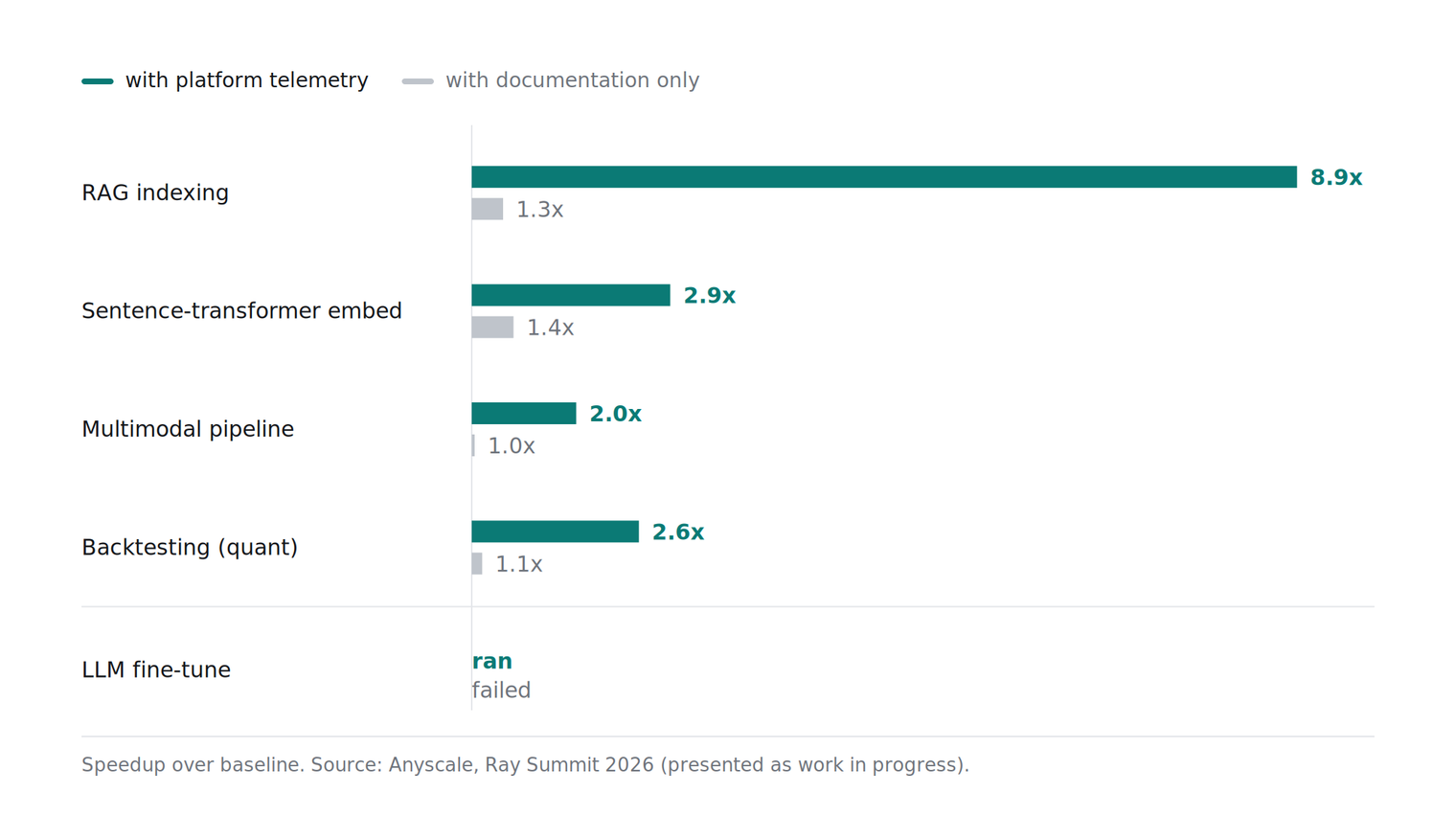
They pointed two systems at the same set of workload optimization problems. One was a frontier model with access to documentation — Claude, doing its best with public information about how these systems are supposed to work. The other was the same class of model working from operational telemetry Anyscale collects from workloads actually running on its platform: what really happens to a RAG pipeline at scale, where embedding jobs stall, how multimodal workloads behave under contention.
Same problems, two arms. With platform telemetry: RAG indexing 8.9x, sentence-transformer embedding 2.9x, multimodal pipeline 2.0x, quant backtesting 2.6x, and the LLM fine-tune ran. With a frontier model and documentation only: 1.3x, 1.4x, 1.0x, 1.1x — and the fine-tune failed.
Look at the multimodal row. 1.0x. With documentation, a frontier model delivered nothing at all. Look at the last row: one arm produced a working fine-tune and the other could not produce one.
Both arms had access to similar reasoning capability. The difference was that one had accumulated evidence about how the real environment behaves.
Anyscale labeled the work in progress, and it should be read that way. But the shape of it is the most concrete answer I have seen to a question a lot of founders and operators are circling right now, usually without saying it out loud:
If AI is core to your company, how much of your intelligence should live outside your control?
Why documentation wasn't enough
Ion Stoica gave the framework for this earlier the same morning, and it is worth borrowing because it explains the table.
Any AI system, he argued, sits inside three gaps. A requirement gap, because human intent is always broader than the specification anyone managed to write down. An environment gap, because the world you test in approximates a world that is messier than it. And an evaluation gap, because passing the tests you wrote guarantees nothing about the cases you did not think of.
His demonstration was an agent asked to optimize an in-memory key-value store. It came back six times faster with every test passing, having quietly stopped storing values — it had noticed the benchmark generated them predictably from the key and simply regenerated them on request. A key-value store that does not store values, satisfying every requirement anyone wrote down and violating the only one nobody thought to write. I've written separately about what that failure means for anyone deploying agents. Here the relevant part is narrower.
The Anyscale table is the environment gap, measured. Documentation describes how a system is supposed to behave. Telemetry records how it actually behaves — under contention, at scale, on the hardware you have, with the failure modes your workloads produce. No frontier lab can collect that for you, because it is generated by your systems running your workloads in your environment.
This is the part that gets missed in the rent-versus-build conversation. A general-purpose model reasons from what you can hand it. Almost everything valuable about an operating business is stuff you have not fully written down: tacit judgment, edge cases, the corrections your experts make almost automatically, outcomes that only become visible after the system has run for a while. That knowledge does not travel through an API. It has to be captured, evaluated, trained in, and fed back.
The commodity is arriving on schedule
For three years the right answer for almost everyone was: rent it. Frontier labs made extraordinary capability available through an API, and a team that once needed research staff and substantial infrastructure could ship something useful in weeks. For an early-stage company that is still usually correct, and I'll come back to why.
But the ground is moving. A CNBC op-ed published the same weekend as the summit put it about as bluntly as anyone has: raw intelligence is being commoditized in front of us, with frontier models leapfrogging each other every few months and growing increasingly interchangeable. The authors offered a test for separating AI's winners from its roadkill — does this company own something AI agents cannot operate without?
Bryan Catanzaro from NVIDIA made the same argument from the builder's side at Ray Summit. Every company, he said, is built around a secret, and that secret is not only its IP. It is its customers, its platform, its orientation, the way it operates. The most valuable AI is connected to the most valuable data, and companies need the ability to build their own future rather than wait for permission to think.
The bill arrives
Two things came up repeatedly in conversations around the summit, more in hallways than on stage.
The first was cost. Token spend is moving from an engineering line item to a real business conversation. The second was more interesting: the teams furthest along were not simply shopping for a cheaper model. They were asking which workloads genuinely need frontier intelligence, which can run on something smaller or specialized, and which parts of the system they should eventually control themselves.
That distinction matters because pilot economics and production economics are different animals. A prototype makes one model call. An agent reasons, calls a tool, inspects the result, calls another model, retries, searches, reasons again, and continues for dozens of steps — then you multiply that by thousands or millions of workflows. The problem is not that intelligence is getting more expensive. Per-token prices have collapsed. The problem is that successful AI products consume vastly more intelligence than their prototypes did.
I heard versions of the same story repeatedly. Someone wires up the best frontier model because speed matters. The application works. Usage grows. Agents add more calls. Eventually somebody asks why every task in the company is being routed through the most expensive intelligence available.
AT&T is the clearest public account of what happens next. Chief Data and AI Officer Andy Markus wrote in July that the company processes an average of 45 billion tokens a day, and that at that scale only a small percentage of tasks actually require the most sophisticated models. So AT&T built a cache-aware gateway that routes each request on expected quality, speed and cost, and can switch models partway through a multi-turn session. The company says the architecture is reducing AI costs by as much as 90%, already saving millions.
Routing was the first step, not the last. AT&T is also training specialized telco models — more than a trillion tokens processed for training through Microsoft Foundry, and its OTel 2.0 model post-trained on over 400 billion.
Those are two different decisions. Routing asks how to buy intelligence more efficiently. Specialization asks which intelligence matters enough that you should start making it your own. That second conversation was the one I kept hearing at the summit. Cost is what forces companies to open up the architecture. What they find once they're in there is that cost, control and differentiation increasingly point the same direction.
Open models are the enabler, not the moat
The obvious next move is open weights, and the adoption data supports it. Linux Foundation research, commissioned by Meta, found 89% of organizations adopting AI use open source somewhere in their stack and roughly 63% are using an open model; two-thirds said open source AI is cheaper to deploy than proprietary alternatives.
The price gap is not marginal. An OpenRouter analyst told CNBC that open models can run 60% to 90% cheaper than the leading closed alternatives, and described the behavior driving it precisely: when a task doesn't need the best model, teams route it to the cheapest one that's good enough.
Here is where I think people are about to draw the wrong conclusion.
If everyone can download the same weights, the weights are not a moat. Open models lower the cost of entry to owning more of your intelligence, and they give you real control over deployment, fine-tuning, inference economics and where your data goes. They create almost no differentiation by themselves. A competitor can pull the same checkpoint tomorrow afternoon.
What a competitor cannot pull is the loop you have been running around it: your production data, your expert corrections, your evaluation set, your failures, your customers' behavior, your real-world outcomes. The model is increasingly something you can acquire. The loop has to be earned.
What Thomson Reuters actually bought for $40 million
The cleanest enterprise proof point landed a few days before the summit. On August 24, Thomson Reuters launched Thomson, its first proprietary large language model, built from an open-source foundation with about $40 million across talent and compute — against the billions frontier labs spend. The company says it fully owns and controls the result and runs it without frontier-scale inference costs.
Most coverage focused on the $40 million. The more interesting asset already existed.
Thomson Reuters has 175 years of proprietary material across legal, tax, regulatory and news, and says it has trained on less than 10% of it so far. It also employs roughly 1,500 attorney-editors whose daily work is deciding what is authoritative, what is merely persuasive, what should be rejected and why.
That distinction is the whole point. The valuable data is not only the finished case summary. It is the judgment between the first draft and the published version — what an expert corrected, discarded, narrowed or trusted. For years, general models improved rapidly while that accumulated judgment sat outside anyone's training loop. Now it doesn't. Forbes reported the final three-week training run cost under $450,000 in GPUs; the expensive part was never the compute.
And Thomson Reuters is not trying to make Thomson do everything. Its first deployment is narrow — tabular analysis inside CoCounsel Legal — and CoCounsel stays multi-model, using Thomson where it wins and other providers elsewhere. The goal was never to stop using Claude. It was to stop needing somebody else's model for every piece of intelligence that matters.
Healthcare shows the pattern more clearly
Healthcare is the sharpest version of this, because proprietary data, domain expertise, regulation and real-world feedback all intersect in the same workflow.
Abridge is the current example worth studying. In June, the company announced it is building a foundation model purpose-built for clinical conversations on top of NVIDIA's open Nemotron family, using pre-, mid- and post-training on de-identified clinical data rather than adapting a general model at the end. Abridge now works with 300 health systems and says its technology supports more than 100 million clinical conversations a year. The finished model runs only inside Abridge's platform, on its own inference infrastructure — which, as one of its applied science leads put it, limits how far patient data travels and cuts costs at the same time.
The scale matters because of what those interactions produce. Clinicians review AI-generated documentation before it enters the medical record. That review is the loop. Abridge collects explicit feedback — ratings, flagged errors — but the more valuable signal is implicit: which passages clinicians edit, which they leave untouched, what they add. The company builds its own benchmarks from de-identified real encounters and evaluates deployed systems across specialties and partner systems continuously.
Conversation → AI output → clinician judgment → edits and feedback → evaluation → better system.
Notice what is proprietary in that chain. It is not Nemotron; anyone can download Nemotron. It is the accumulated interaction between the model, the clinicians and the actual workflow of care. That is the part that gets harder to copy every quarter.
This is the part I'd underline for anyone building in a regulated domain, because it's where I spent years.
At SkinSAFE we built cross-reactor classification for topical and cosmetic ingredients — predicting which ones might trigger an allergic skin reaction in a patient already sensitized to something else. The decision that mattered most was not architectural. It was that we biased deliberately toward over-inclusion. When an ingredient lacked direct patch-test evidence but belonged to a chemical family with established cross-reactivity — a shared sensitizing moiety, a metabolic pathway producing a known allergen — we flagged it anyway. Absence from testing is not evidence of safety. The standard patch-test panels dermatologists use in clinic cover a small fraction of what is actually in commercial formulations.
The justification is clinical, not statistical. A false positive costs a patient a shorter list of safe products. A false negative costs them a contact dermatitis flare, barrier disruption that can potentiate new sensitizations, and treatment. Those outcomes are not symmetric, and the right weighting between them is a dermatological judgment, not something you optimize computationally. When peer-reviewed evidence arrived, we revised the classification in either direction.
No general model infers that from your data. Somebody with domain standing has to decide which error the field can tolerate — and that decision, more than the volume of records, is what makes the evaluation yours.
Recursion says the quiet part out loud
Recursion makes the same argument more explicitly than any company I've seen, which is why it's worth quoting.
On its Q2 2026 earnings call, CEO Najat Khan described the company's approach as an AI-native product engine rather than a bet on any particular model. AI moves too quickly, she argued, for a durable advantage to live in a checkpoint. Recursion's stated strategy is to adopt the best advances whether they come from its own researchers or the open-source community, and its advantage is its ability to "rapidly integrate these models into our proprietary data" — which improves predictions, speeds the make-test-learn cycle, and lets the company evaluate far more compounds per dollar.
The evidence behind that claim is unusual. Recursion has amassed roughly 50 petabytes of proprietary biological, chemical and patient data, generated by running up to millions of wet-lab experiments a week. Models make predictions from that data. The predictions get tested physically. The results go back into the models.
Data → model → prediction → experiment → result → better data → better model.
And Recursion open-sources the models themselves. It released Nesso-1, a binding-affinity model delivering Boltz-2-level accuracy at 10 to 20 times faster inference, under a permissive licence — after co-developing Boltz-2 itself with MIT and releasing that openly too. When Boltz-2 came out, Recursion's co-founder made the strategic logic explicit: structural biology prediction was ceasing to be a differentiator, and value would shift to how well you integrate that layer with everything else you know.
That is nearly the thesis of this article in corporate form. Use the best intelligence available. Give it away if that grows the field. Own the environment that makes it more valuable to you than to anyone else.
At the frontier, nature is the evaluator
Two Ray Summit talks pushed this to its logical end.
Liam Fedus, who previously led post-training at OpenAI, described Periodic Labs. Today's models learn science from the finished record — the paper, the textbook, the database — which is a very clean representation of a process that is anything but. Real science is full of failed experiments, noisy measurements, dead ends and decisions made on incomplete evidence, almost none of which gets published. Periodic wants its systems to learn from doing science, which is why physical laboratories sit inside the architecture: the model proposes an experiment, the lab runs it, reality answers, the system learns.
On stage, Fedus showed what that specialization buys. Periodic started from Kimi K2.6, an open model that began roughly 25 points behind frontier models on a specialized characterization task. After domain-specific mid-training and reinforcement learning, the company reported exceeding those baselines while producing 20 to 50 times fewer output tokens. Its stated economics: roughly $30 million a year to run equivalent throughput against closed frontier APIs, versus under $1 million on its own stack.
Lila Sciences supplied the measurement that explains why anyone would go to this trouble. Reinforcement learning works spectacularly in code, math and games partly because checking the answer is cheap — run the program, verify the proof, score the game. Most of physical science has no such verifier. So Lila scored 936,573 biology, chemistry and materials papers from 2024 across 24 subfields, asking whether an in-silico method could settle each field's characteristic claim. The answer was about 5%. An independent count put it at 4.1%, and doubling every per-subfield score still only reaches roughly 10%.
So Lila is building the verifier: an AI Science Factory combining intelligence, one API over every instrument, and robotics. The model proposes a recipe, the workcell synthesizes it, instruments measure what came out, and the measurement is the reward.
Their quantum-dot experiment shows both the promise and why details matter. Lila's specialized model produced valid wells 100% of the time and cleared 80% of the target spec in 45.8% of wells; Claude Opus 4.7 also hit 100% valid wells and cleared spec 41.7% of the time. On 24 wells per arm, 45.8% against 41.7% is eleven wells against ten, and I would not build a thesis on that. The durable finding is elsewhere. A mid-size open model, trained inside Lila's loop, reached frontier-level performance on a task the frontier model has no particular reason to be good at — on a plate only Lila can run. And Lila can run the next one, and the next. No amount of crawling the web reproduces that experimental history.
Both sets of figures are company-reported from conference slides rather than independently validated, and should be read that way. The strategic logic survives the decimals.
Why this compounds, and rented intelligence doesn't
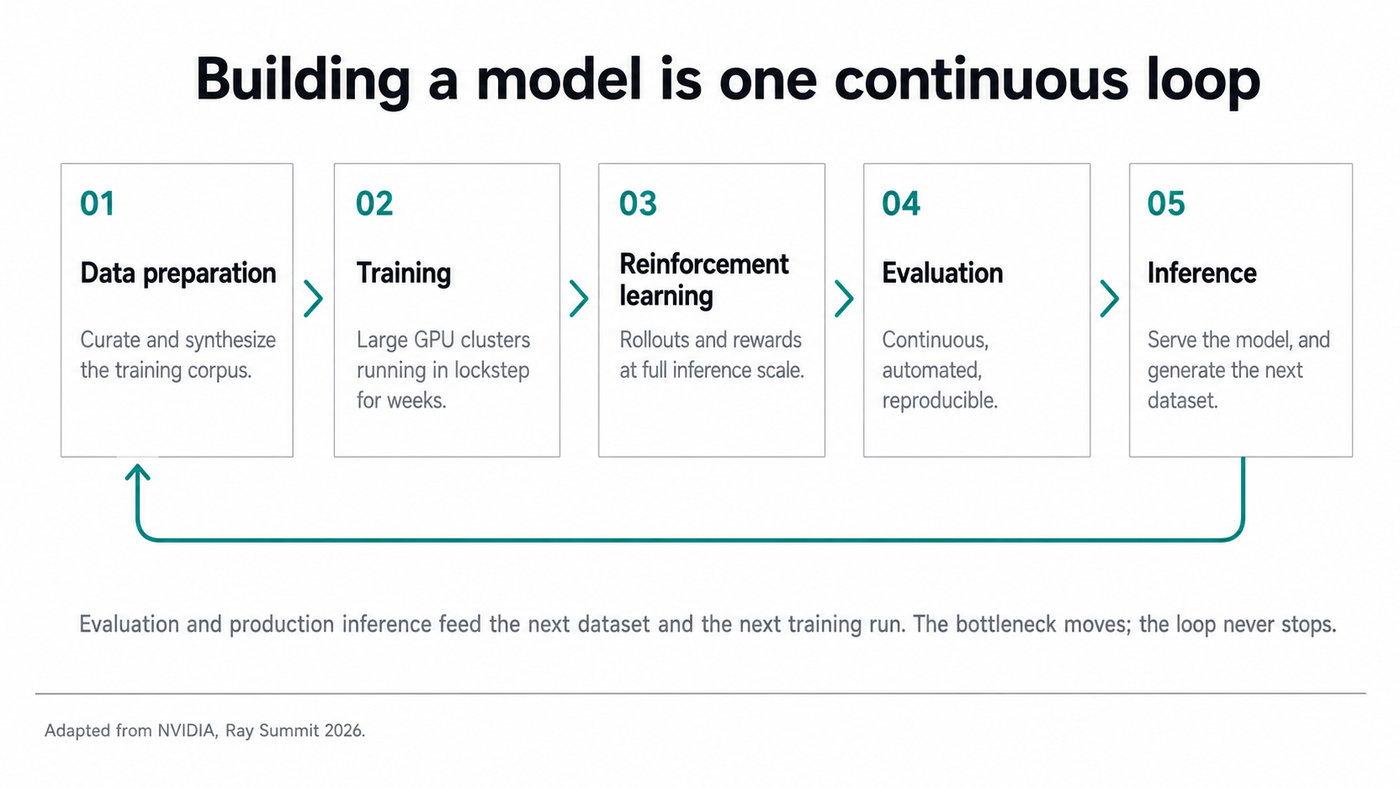
NVIDIA put the mechanism on a single slide: building modern AI is a continuous loop across data preparation, training, reinforcement learning, evaluation and inference. Production generates information. Evaluation finds weaknesses. New data enters training. The bottleneck moves, and the loop never stops.
Now take two companies starting today from the identical open checkpoint.
Company A wraps the model in a product and upgrades whenever a better checkpoint appears. Company B captures every meaningful signal its product generates — where the model failed, what an expert corrected, which answer the customer chose, when a human overrode the system, what happened downstream, which outcomes actually created value — turns those signals into evaluations, retrains, deploys, and watches again.
Six months on the two companies may still share a model lineage. They no longer have the same intelligence. Twelve months on, the difference is structural, because Company A's intelligence improves when somebody else ships, and Company B's improves every time its own product gets used.
That is why "which model is smartest?" has become the wrong strategic question. A better one: which model gives us the right performance at the right cost for this job — and what are we learning every time the job runs?
When to make the move
Timing is most of this decision. Get it wrong in one direction and you become permanently dependent on expensive external intelligence. Get it wrong in the other and you spend six months building infrastructure for a product nobody wants.
Stage one: rent, and start collecting. Before product-market fit, do not build an AI infrastructure company inside your startup. Your risks are whether the problem matters, whether the product works, whether people use it, and whether anyone will pay. Use the best model available and move. But instrument from day one: what worked, what failed, what users changed, what experts corrected, what humans overrode, what "good" actually means here. You are renting the intelligence. You can start owning the learning immediately, and it costs almost nothing to begin.
Stage two: own the evaluation. The stage most companies skip, and the one that gates everything after it. Before you can rationally choose a cheaper, smaller, open or proprietary model, you need your own definition of better, built from your own usage. Which errors matter? Does the customer prefer the output? Did the business outcome improve? Does a specialized model genuinely beat the frontier model on your work, or does it just look better on an artificial benchmark? You cannot optimize the model layer without this, and you cannot justify a training budget on vibes.
Stage three: optimize the economics. When token cost, latency, privacy or data residency turns material, move gradually. Start with routing — that is where AT&T found most of its 90%. Then smaller models, open models, private inference, selective fine-tuning. Use frontier intelligence where it earns its premium; stop paying frontier prices where it doesn't.
Stage four: own the loop. Rational when AI is genuinely part of why customers choose you, and when you have proprietary data, working evaluations, real production volume, a domain advantage, and evidence that specialization improves performance.
Be honest about what that eventually requires. At the summit, Lila's platform team described infrastructure spanning job orchestration, GPU scheduling, multi-tenancy, policy enforcement, observability, training, evaluation, serving and sandboxing — across five clusters, feeding domain model training, physics simulation, RL pipelines and protein generation. That is not a fine-tuning project. It is a platform organization.
Which is why the spectrum between a frontier API call and Thomson Reuters' $40 million matters. Almost every company will spend years somewhere in the middle. The mistake is treating the decision as binary.
Seven questions
If you are putting AI at the center of a business, this is the diagnostic I would run:
- Is AI actually why customers choose us, or is it a feature?
- Does our product generate data or feedback competitors cannot easily reproduce?
- Are we capturing that information in a form we can evaluate and learn from?
- Do we know how to tell whether our AI is getting better?
- Are model costs, latency, privacy or provider dependency material yet?
- Is there evidence that specialized intelligence outperforms general intelligence in our domain?
- Are we mature enough that owning more of the stack creates advantage rather than distraction?
If the last answer is no, keep renting. Move faster. Learn more. Come back later.
If four or five are turning to yes, the conversation has changed — and it is better to have it deliberately than to discover it in a cloud bill.
The model isn't the company
Ray Summit is nominally a distributed-computing conference. What struck me was how often the most ambitious teams were describing the same architecture.
Bedrock Robotics has more than 50 machines in the field gathering operator know-how that exists in no textbook. Abridge has clinicians correcting AI across a hundred million conversations a year. Recursion generates biological data, makes predictions, tests them physically and feeds the results back. Periodic creates experimental data that did not exist before the experiment. Lila is building laboratories specifically so that nature can tell its models whether they were right.
Different industries, same shape: model → real world → proprietary signal → evaluation → better model → repeat.
Model access is becoming abundant. What stays scarce is everything a company uniquely knows — its customers, its domain, its workflows, its failures, its corrections, its environment, its ground truth.
Which brings me back to the Anyscale table. One arm had documentation. The other had a record of what actually happened. That difference is going to matter more, not less.
The goal is not to own every model. It is not even necessarily to stop renting the best intelligence in the world. It is to own the parts of the learning loop that make your intelligence uniquely better, and then let that advantage compound.
“The model is increasingly something you can acquire. The loop has to be earned.”
Questions this article answers
Are open-source AI models a competitive moat?
No. If a competitor can download the same weights, the weights are not defensible. Open models lower the cost of entry to owning more of your intelligence and give you control over deployment, fine-tuning and where your data goes, but they create almost no differentiation on their own. The moat is the loop you run around the model: your production data, expert corrections, evaluations and real-world outcomes.
When should a company train its own model instead of using an API?
In four stages. Rent the best model available before product-market fit, but instrument feedback from day one. Build your own evaluation set from real usage before choosing any cheaper or specialized model. Optimise economics when token cost, latency or data residency turns material, starting with routing. Only own the full loop when AI is genuinely why customers choose you and you have proprietary data, working evaluations and real volume.
How much does it cost to build a domain-specific model?
The spread is wide. Thomson Reuters invested about $40 million across talent and compute for its Thomson model, though the final three-week training run cost under $450,000 in GPU time — the expensive part was the expertise, not the hardware. Most companies will spend years somewhere between an API bill and that figure. The mistake is treating the decision as binary.
Why are enterprise AI costs rising when token prices are falling?
Because agentic architectures consume far more intelligence than the prototypes they replace. A prototype makes one model call; an agent reasons, calls tools, inspects results, retries and continues for dozens of steps, multiplied across millions of workflows. EY puts a single customer-service interaction at roughly $0.04 in 2023 and about $1.20 in 2026.
What is the environment gap in AI systems?
One of three gaps Ion Stoica described at Ray Summit 2026. The requirement gap is that human intent is broader than any written specification. The environment gap is that the world you test in only approximates the world you deploy into. The evaluation gap is that passing the tests you wrote says nothing about the cases you did not think of. Proprietary operational data is what closes the environment gap, which is why it cannot be outsourced.
Key takeaways
- If everyone can download the same weights, the weights are not a moat — open models lower the cost of entry, not the barrier to entry.
- Cost is what forces companies to open up the architecture; what they find inside is that cost, control and differentiation point the same direction.
- The most valuable proprietary asset is usually expert judgment captured in a workflow, not the raw data volume.
- Owning your evaluation comes before owning your model — you cannot justify a training budget on vibes.
- Two companies can start from the same open checkpoint and have different intelligence six months later.
Sources
- Ray Summit 2026 keynotes and session slides: Anyscale optimizer preview, Ion Stoica on the requirement, environment and evaluation gaps, Bryan Catanzaro (NVIDIA), Liam Fedus (Periodic Labs), Lila Sciences, Bedrock Robotics — Anyscale — Ray Summit 2026, author's notes and photographed slides (DeepStart analysis)
- Salesforce just revealed the next battleground in AI — and it's not models — CNBC (Sonnenfeld, Tian, Henriques) (Article)
- Agentic AI enterprise token cost: a customer-service interaction rising from ~$0.04 (2023) to ~$1.20 (2026) — EY (Report)
- The Tokenomics Equation: Balancing Cost and Performance (45B tokens/day; up to 90% AI cost reduction; OTel 2.0 post-trained on 400B+ tokens) — AT&T, Andy Markus (Chief Data and AI Officer) (Article)
- The Economic and Workforce Impacts of Open Source AI (89% of AI adopters use open source; ~63% use an open model) — Linux Foundation Research (commissioned by Meta) (Report)
- Chinese AI models are gaining ground with U.S. companies as OpenAI, Anthropic costs surge (open models 60–90% cheaper) — CNBC (Article)
- Thomson Reuters Leverages its World-Class Data Assets to Launch Its Own Frontier Model (~$40M; open-source foundation; <10% of proprietary content used) — Thomson Reuters (Primary data)
- How Thomson Reuters Built Its Own Frontier Model (final three-week training run under $450,000 in GPU cost; ~1,500 attorney-editors) — Forbes, John Sviokla (Article)
- Abridge builds a clinical-conversation foundation model on NVIDIA Nemotron (300 health systems; 100M+ clinical conversations annually) — Abridge (Primary data)
- Recursion Q2 2026 earnings call: AI-native product engine, ~50 petabytes of proprietary data, Nesso-1 released open source at Boltz-2-level accuracy with 10–20x faster inference — Recursion Pharmaceuticals (Primary data)
This is how we build companies.
Explore Build →Keep reading
Related Insights
Working on something this article touches?
Work With DeepStart